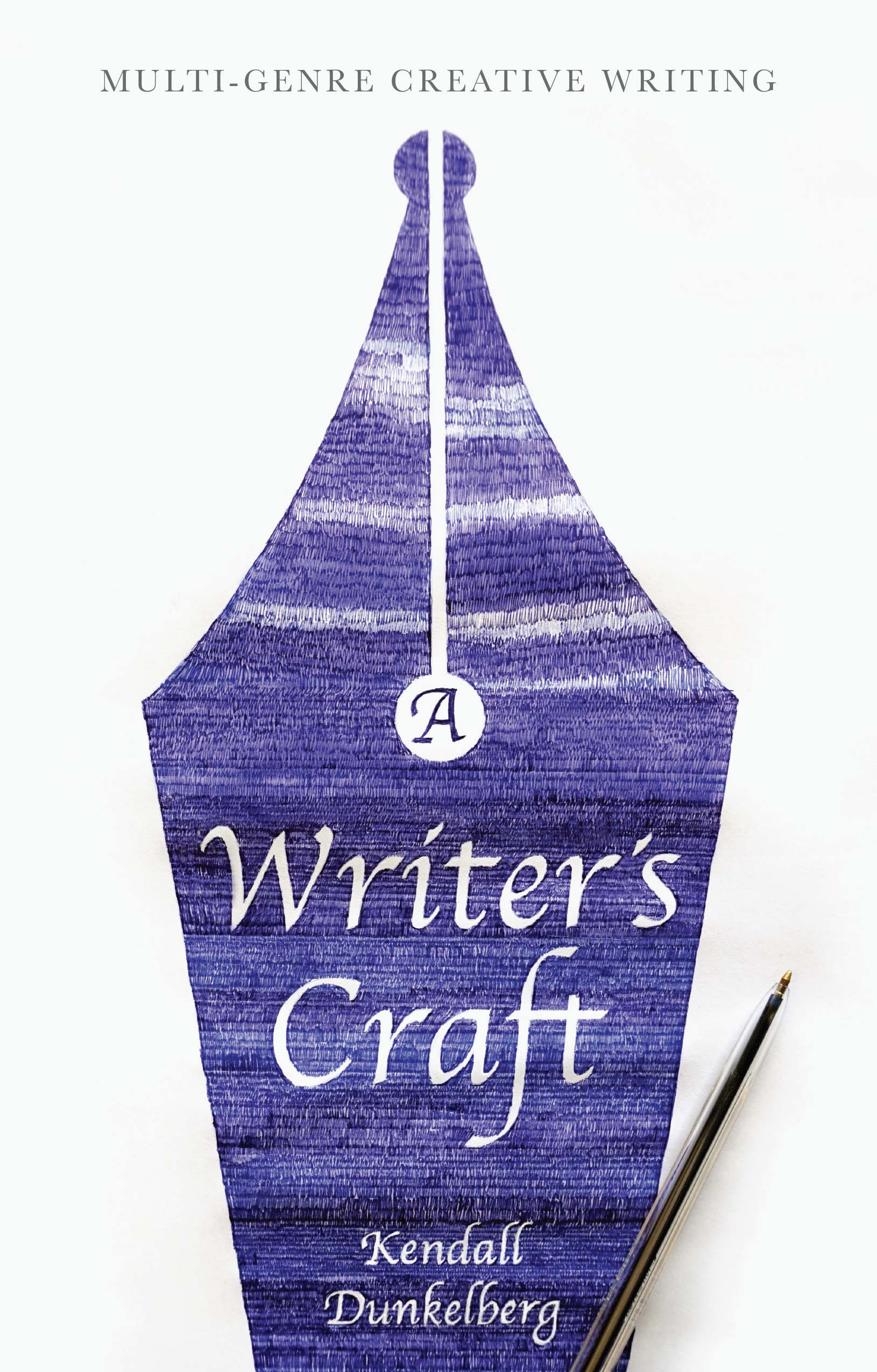
The big news of the week (besides the fact that I’m back from sabbatical and the Spring 2026 semester started this week) is that I sent of the manuscript for A Writer’s Craft: Multi-Genre Creative Writing, 2nd Edition. I’m using the first edition cover for this post because that’s where I started my revisions and because I won’t have a new cover for awhile yet, but you can bet I’ll post about that as soon as it’s finalized. We haven’t even begun talking about that yet, but I have spent the last several months of the Fall 2025 semester working on the manuscript.
When I sat down with my last good version of A Writer’s Craft, 1st Edition (always save your files!) and contemplated how I could turn it into the second edition I had envisioned in my proposal to Bloomsbury, my first thought was that I needed to follow my own $%#& advice. I knew I would need to cut as well as add, in other words. I knew I would have to be brutal and brave enough to make significant changes, yet hold to the tone and the content of the original. And may I say it felt a little daunting in August when I began on Chapter 1?
In fact, as I recall, I didn’t complete revisions to the first chapter until I had made a good pass through Chapter 2 at least. I set myself a goal of revising a chapter a week, yet in the first weeks I didn’t stick to that entirely. I did reach it by the end of the second or third week, but I moved forward through those first chapters at a somewhat different pace until I settled in and stuck to my plan. And I was okay with that.
Roughly speaking, here is my weekly schedule for revising a chapter a week. On Monday, I would read through the new chapter and make a plan for revision, consulting my book proposal and looking for other writing I had done on the subject, such as blog posts or notes for teaching creative writing. On Tuesday and Wednesday, I would rewrite, adding as much content as I felt I needed, especially coming up with examples from literature that I could use to illustrate my points, since that was one of the main comments of the peer reviews I got back. In this initial revision, I did not worry about length, but by Thursday when I made my next pass through the chapter I would both focus on cutting back to meet my chapter length target and on adding to cover any areas I missed in my first revision. Friday’s revision would usually focus on cutting every word I could, even whole paragraphs, to get back to the target length for the chapter. Then next week, I would start over again, reading and planning revisions for the next chapter, which often meant going back through the previous week’s chapter once again as well.
In other words, each week I followed the advice I give in the book. Write to get your thoughts on paper without worrying too much about the final form initially. Be willing to write words you won’t end up using in order to get to the words you will keep, and be willing to cut , reshape, and rephrase the words you’ve sweated blood getting on the page in order to make a stronger, clearer, and more concise final product. It was always important to get some distance after Friday’s “final” draft and look back the following week to see what I had done and continue to refine.
In the end, after an intense 15 weeks of revising a chapter week, I spent a week revising the entire manuscript again in one week, which helped me to catch a few inconsistencies and a duplicated passage or two. Then I worked on things like tracking down quotes and preparing the manuscript to send to my editor. I did those last tasks off and on over the holidays and as I was getting ready for the spring semester.
So, you are probably asking, what did I revise? A lot, to be honest. And a lot more than I could ever describe in one post, but I can give a few highlights. Let’s start by saying that the total manuscript went from 60,000 words to 109,477 words, so I essentially wrote another book—except I didn’t. Most of the what was in the first edition is still in the second, though I did cut a lot out as well — not content, but words. I was conscientious when revising, especially the second and third times through, to be as brutal with my original prose as I was with what had been added.
It is a leaner volume with much more tofu (sorry, I’m a vegetarian, so i don’t want to call it “meatier”). A chapter often would reach nearly 10,000 words on the first pass-through, and I would then bring it back to at most 8K. The early chapters weigh in at around 6.5-7K, and I did my best to keep the chapters on genre to just over 8K apiece. This was up from 4-6K with one outlier that was 7K in early chapters of the first edition, and 5-7K for the chapters on genre. One result of actually counting the words in each chapter is that the chapters are now much more consistent in length.
Thank you to LibreOffice who easily showed me my word count and to my editor for encouraging me to stay within my limits, even though she agreed to increase the target early in the process when our estimate that the 2nd edition would have 30% new content was clearly not enough. The second edition is has 83% more content by may calculation (based on word count). Considering that I probablly cut close to 20%, it really is like doubling the size of the book. I really did want a second edition to be worth it for those who buy the book.
Some of the things I added: a discussion of AI in the Introduction, Chapter 2, and Chapter 14 where I return to consider whether AI-generated texts are literature (there are different ways to look at it, but for one, I consider the copyright implications of AI); an expanded discussion of “reading like a writer”; a discussion of writing in other languages and bilingual writing; more discussions of cultural bias or appropriation; sections on non-Western forms of narrative structure; more sections on specific forms of poetry, including non-Western forms like the haiku, the ghazal, and the pantoum, as well as nonce forms like the Golden Shovel and the duplex; a revised discussion of narrative time in fiction; an expanded discussion of lyric essay and offshoots like the hermit crab essay and the braided essay; updated formats for playscripts, including those used outside the U.S.; a section on writing screenplays, including a format for writing a spec script; and a thoroughly revised and expanded Chapter 14, now titled “New Genres” that includes a discussion of digital writing form like the hypertext story, social media and maps, and interactive fiction. There are also new Notebook Exercises in every chapter (each chapter after the Introduction has a dozen exercises), and there are now two Group Exercises in every chapter, including some that are labeled Small Group Workshop exercises to give examples of how small group workshops might be conducted.
That’s a fairly long list, and it only scratches the surface, but it should give the idea that the second edition is much more multi-cultural (something the first edition was open to but wasn’t as explicit about) and multi-national (knowing that the book is used in England, Australia, and many other countries made me even more focused on shifting my perspective and making it more global). It is also much more specific, going into detail about forms and strategies that in the first I had left for the instructor to cover the way they wanted to. Much of that detail comes from having taught for another decade since I wrote the first edition, and having taught gradaute students as well as undergrads, and bringing some of the lessons I learned from working with my grad students into my undergraduate classes over the years. Much of that detail also comes from paying attention to what has been going on in the field of creative writing pedagogy over that decade, as well as from my own experience as a writer over that time.
I’m not a fan of textbooks that come out with a new edition every few years, but a decade is long enough, and I knew I had more to say. I just couldn’t predict how much more that would be until I really dug into the work. It was an intense 16+ weeks to revise 14 chapters plus the end-matter (appendix, glossary, and resources), and then revise the whole book again in one week. It was a wild and rewarding ride!
P.S. At no point in the process did I use AI. I chose to write in LibreOffice because a) I lost part of an early revision due to issues I was having in Word, losing a day or two’s worth of work (I have amnesia about that) and b) because LibreOffice so far does not constantly ask if I want its AI assistant to help me write (it doesn’t have one as far as I can tell). I turn AI off of my search engine, and I don’t rely on anything other than the included spelling and grammar checking functions in LibreOffice that underline words. The last thing I want is for AI to start suggestion what word it thinks I might write next. I can second-guess myself, thank you very much. I don’t need AI to do that for me.
 Kendall Dunkelberg