This morning, I took a few moments to write on Substack about seeing a scarlet tanager and a couple of catbirds, two bright spots on what turned into a rainy day. Tonight, I happened across a review of the reading I did with John Miller at Ernest and Hadley Bookstore back in February. Since that also brightened my day, I thought I’d write about it here.
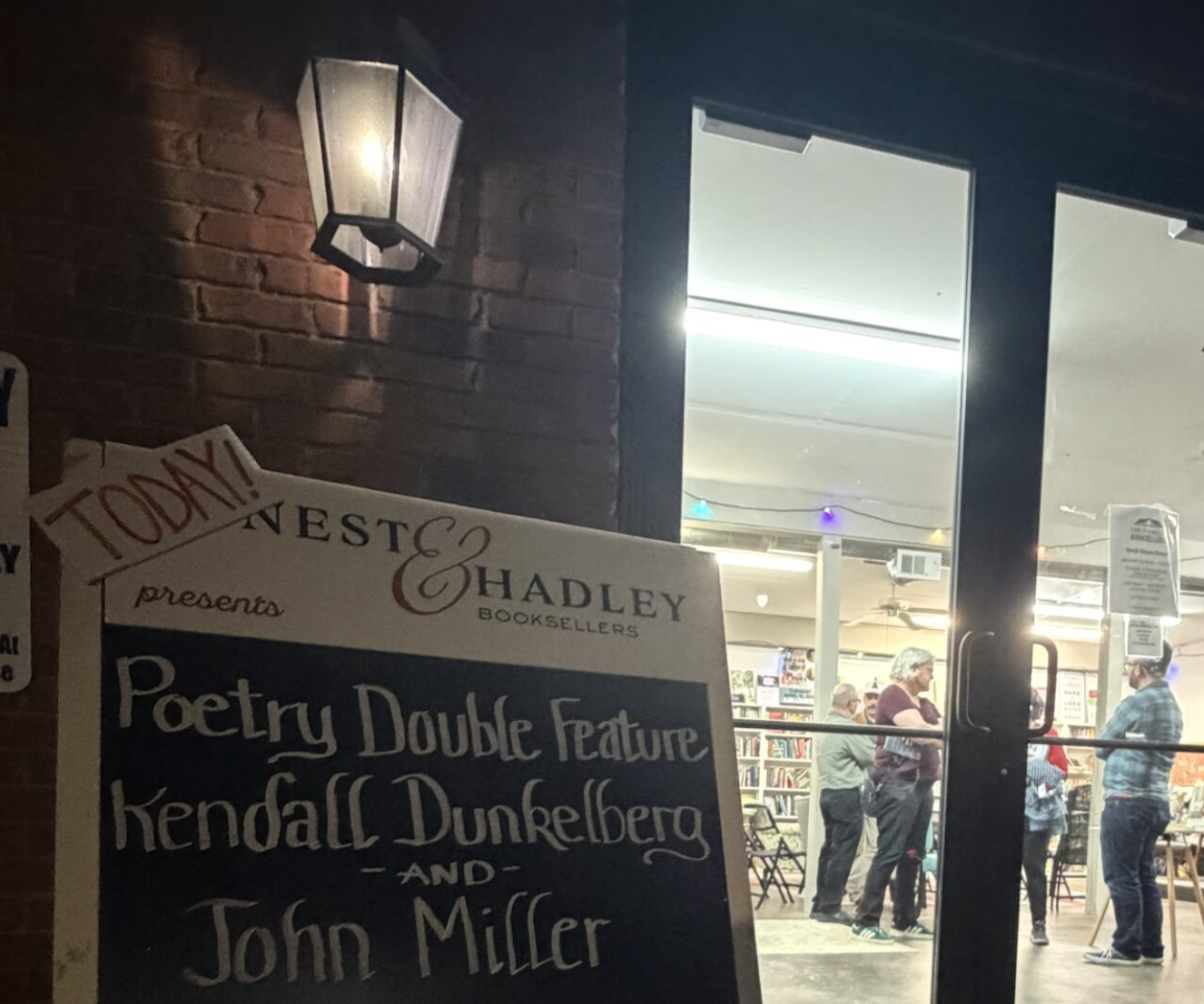
I took a screen shot from part of the cover image on the review, since I didn’t want to dowload the whole picture. Credit to Lilly Roehrig, who I assume was the photographer for this and two other photos that accompany her piece in Ripple Arts Review, a publication of the University of Alamaba English Department.
Lilly has a very good eye, and a good ear for poetry, and I’m not just saying that because she said nice things about my poems, though that never hurts. This is a well-written piece that examines more than John’s and my poems, but also reads the room and reflects on the writer’s own place in that space. She senses a tension between herself and the rest of the crowd, since she was the youngest person there. I get that, though I hardly noticed the age differences, being just as much of an outsider to the Tuscaloosa poetry scene.
For Lilly, the difference was between the university student and the town; for me the difference was living an hour away. I had the advantage, though, in that I was an invited guest and knew a few people: some former students were there, and I knew John from emails and sharing poems through Poetry South.
What Lilly probably didn’t realize is that many of the people in the room were in a similar boat. I talked to one person who had driven from Jackson, Mississippi, for the reading. He knew John, but probably didn’t know anyone else. One of my former grad students had come in from just the other side of Birmingham, the other is a fairly new PhD student in French who recently moved into Tuscaloosa. I talked to another young man who had come in from out of town and didn’t know either John or me, but had just seen a post about the reading. We might have all looked like we were a group because of the age difference, yet we were not a monolith.
But I get that it’s intimidating to go outside your comfort zone, especially as an undergrad on a campus large enough to be its own city. So kudos to Lilly for making the leap and also for acknowledging that she and her friends should do that more often. Lilly’s take-away from the reading and her own ambivalent feelings of discomfort and anxiety while still being welcomed, is that college students need to seek out more opportunities to interact with the local poetry scene, for as she notes, “excellent poets await you.”
I would add that the local poetry community might also more inviting. Maybe Ernest and Hadley could host a student reading in their space. And maybe they have; as an outsider, I have know way to know. I’m not thinking specifically of the poetry scenes in Tuscaloosa, in other words, but more about all of us. We need to be more willing to get outside of our comfort zones and experience what other people are up to, even when that is unfamiliar or a little intimidating.
For that reason, I also enjoyed reading Lilly’s article about an Eco-Poetry workshop she attended at the Turkey Creek Nature Preserve in Pinson, Alabama near Birmingham. This is another good desecriptive piece about making the leap to get outside of your own community and explore nature (and another community) about an hour away. Again, she dicusses both the poet Erica E. Wade and her own reaction to the workshop and the natural area, including its history and the community activists who stopped the development of a new county jail, turning the area into a nature preserve instead. She compares this successful action to the still ongoing, and so far less successful action against a data center in Bessemer.
Note to Lilly: I happen to know that one of my grad students, who was at the reading that night, is also deeply involved the the fight against the Bessemer data center and has written on it extensively. You had more in common than you realized.
We need more young poets like Lilly who are willing to get outside their comfort zones and explore, whether that is to go to readings in unfamiliar spaces or to drive an hour away to experience and write poetry and learn about the history and the environment of a new place. Maybe we have more of those poets, young and old, than we realize. Maybe we just need to connect with them by doing the same.

