How to Read a Book of Poems

This question has come up at some of my readings this month for Tree Fall with Birdsong, so I thought it might be worth blogging about. The question usually arises from my discussion during a reading about how some of the poems are related or about the section of the book that a poem appears in. I often talk about a book section as a poem cycle, and that leads people to wonder: should they read the book cover to cover in order, or is it okay to skip around and read poems individually, which seems to be a common practice, at least of those who ask the question.

My answer is, yes. It’s okay to skip around, and yes, many poetry collections are meant to be read in sequence. That is to say, most poets spend a lot of time and thought on arranging a collection in a particular order. It is not just chronological, though with my collections there is often a somewhat chronological order to the sections of the book. Individual poems, though, might have been written at very different times. I might write one poem early in a book’s history, and then come back to that theme again much later and write poems that go with one or more earlier poems. Or I might move poems around between sections to weave certain themes together, rather than having all of one theme in one section.

When putting a collection together, I think a lot about how one poem might lead into the next poem, and I want them to speak to one another in an order that is consciously arranged. I’m a poet who wants the experience of reading the collection in order to be meaningful and to lead to new insights that you might not get if you read poems individually. Yet I also acknowledge that many readers prefer to read that way (or do that out of habit), and that is all right.

After all, poems are written as individual pieces. They are meant to stand on their own and often appear initially in a completely different context, in a literary magazine, for instance. As editor of Poetry South, I also spend time thinking about the order of each issue and how poems speak to one another in that context, so I hope some readers will the magazine in order, too. I’m always mildly annoyed with magazines that organize their contributors alphabetically — that’s convenient, both for the editor and for the reader who wants to find a poem by a particilar poet (but that’s what the table of contents is for) — but I still like to curate the experience.

I like to think of a poetry collection and even a poetry magazine as analogous to an art exhibit. If a gallery owner hung paintings alphabetically by artist or by title, that would be within their rights, but it would also be somewhat disappointing. There’s so much more to discover when art or poetry is arranged intentionally so that the individual pieces can be in conversation with each other.

In my interview in Southern Review of Books with C. T. Salazar, we got into a discussion of how the poems in “Tree Fall” echo one another with certain lines or phrases coming back recursively in each. If you don’t read the poems in order, then you likely won’t catch this use of repetition, and you won’t see how the phrases evolve over the course of the sequence. Sometimes I think of a book as one long poem in several movements. The composition of the book took place individually over a long period of time, but the book coalesces when the connections between poems begin to emerge and an order gradually emerges.

But in the end, it is your book once you buy (or borrow) a copy. If you want to skip around and read the poems that strike your fancy first, by all means, go ahead. I would encourage you to reread it at least once by reading cover to cover, but maybe you want to do that only after you’ve discovered your favorite, so you then can see them in a new light upon rereading. Or read it cover to cover once, and then go back to your favorites to read again and again. A poem should stand on its own and be meaningful without any additional context. A collection adds to and deepens that meaning by arranging the context and providing the reader more to go on, if they are willing to read it in order.

At least my poetry books are arranged this way. I’m sure there are other poets who don’t do that as much. I see more collections these days that don’t include sections and simply present the reader with a single series of poems with no pauses or breaks. Maybe some of these poets expect readers to read out of order, so they don’t worry about sections or cycles. Or maybe they care equally about the order, but don’t want to indicate where to pause or how to group the poems. Poets are not a monolith, after all, and we all have our own ideas on how a collection can come together.

July Update: Book Events and Interview

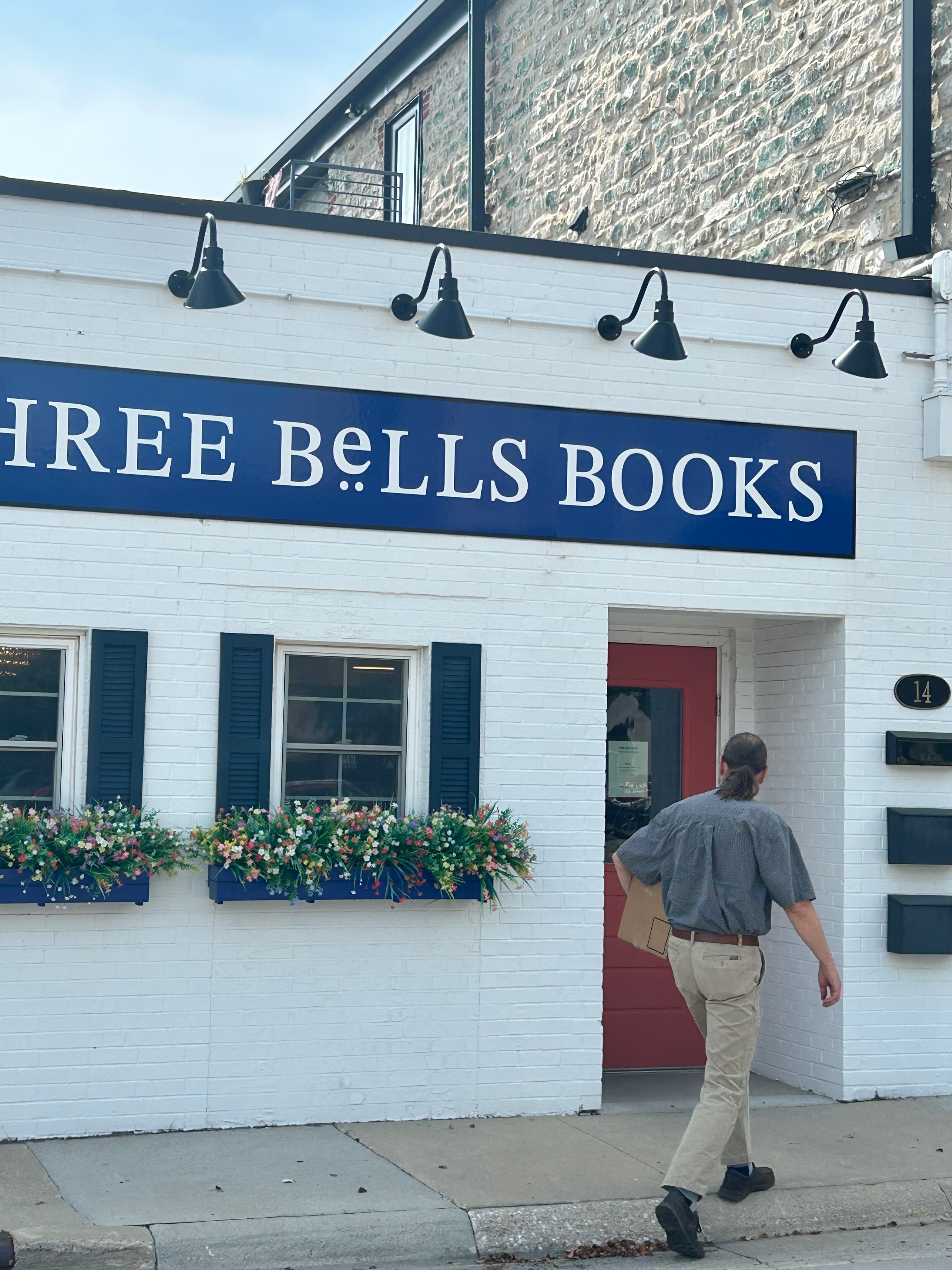
This is a quick post to let people know how my July is going. I’ve had a great time in Iowa at three book events in Osage, Charles City, and Mason City. I got to know the owners of two local bookstores, Prologue Books and Wine and Three Bells Books, which were new to me, and also connected with a store in Osage, Create, that will calso arry my books. They promote local authors and also sell art and other creations. Each has its own niche and is doing quite well by the look of their stores.

Today, the interview in Southern Review of Books went live. Thanks again to C. T. Salazar for his insightful questions and for Southern Review of Books for agreeing to do the interview.

Finally, when we get back to Mississippi next week, I’ll be gearing up for my reading at Lemuria Books on July 24 at 5pm. I’ll also be signing books, so I hope to see anyone whose in Jackson, Mississippi!

Other upcoming events that are confirmed include the Possum Town Book Festival in August and the Mississippi Book Festival in September. It’s going to be an exciting summer and early fall, and I’m looking forward to announcing more news soon.

Heading Back to Iowa

I’ve always looked forward to our summer pilgrimage to Osage, Iowa, which we usually take this time of year, arriving in time to go to the annual Fourth of July Parade and stop down to the fairgrounds later that day for some locally made ice cream from the Dairy Association. This is the time of year to make rhubarb jam and rhubarb pie, and if we’re lucky we’ll be around for an ice cream social or two.

But this year will be a little different, since my Mom passed away in January at the age of 97 and half. The house will be empty of her presence when we arrive, though we also have a lot of cleaning out to do: sorting, reminiscing, and deciding who will take what and how much we will leave for the estate sale. My brother will be in town, and our son is joining us. My neighbors, Martha and Joel Dorow, will both be there for part of the time, and my brother-in-law will also be there for a while before we all go to a family reunion. It will likely be the last time we are all together, at least in the little brown house on Poplar Street. So it will be bitter-sweet in many ways.

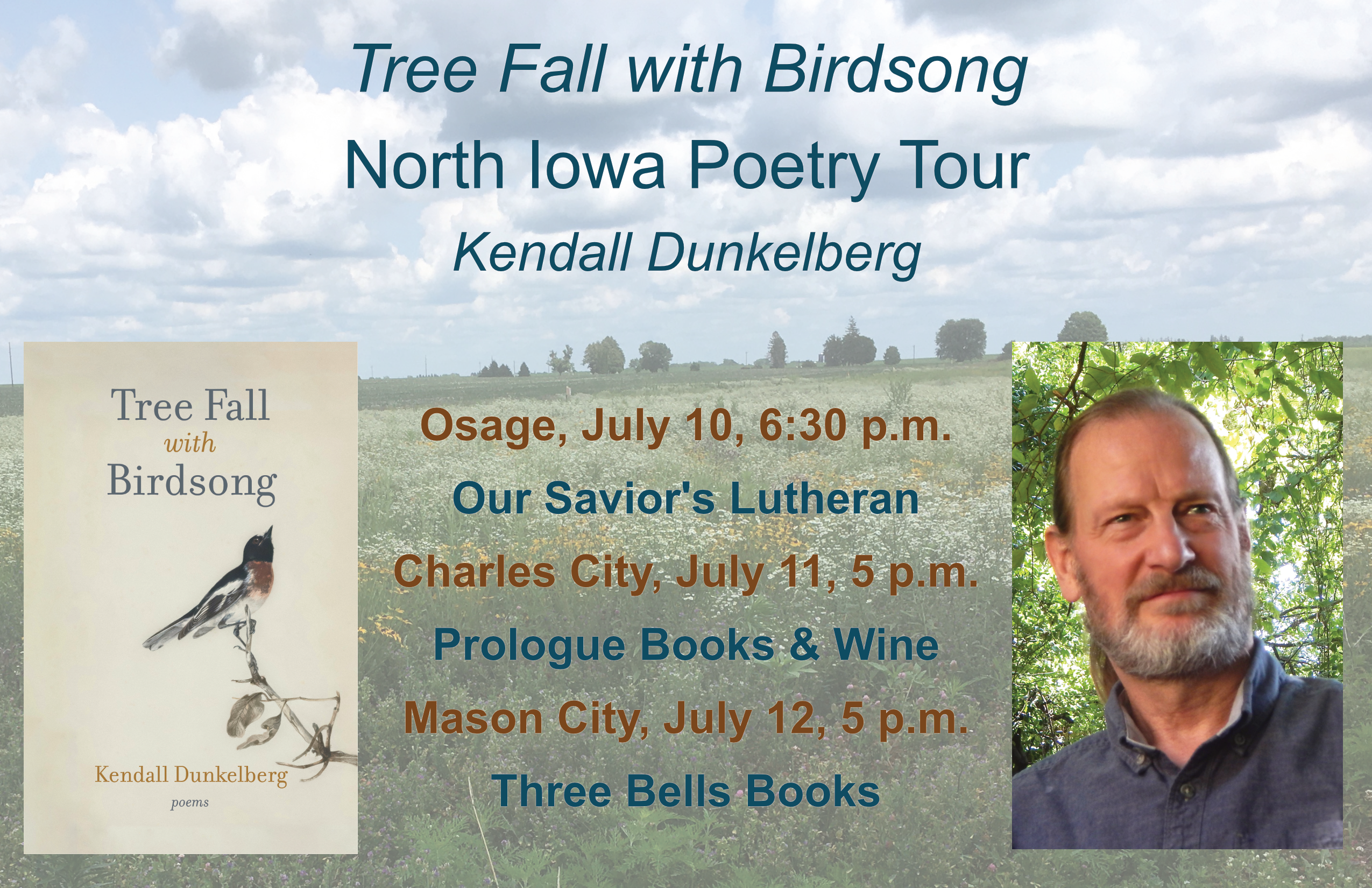
Since Tree Fall with Birdsong is just out, I have also set up some readings, first with the Alpha Writers and the Fine Arts Council of Osage on July 10 at Our Savior’s Lutheran at 6:30 p.m. in the Fireside Room, and then July 11 at Prologue Books and Wine in Charles City and July 12 at Three Bells Books in Mason City, both at 5pm. It will be great to be able to see people from Osage and get to know these fairly new independent bookstores, which I’m always happy to support.

By the end of the month, I’ll be back in Mississippi for The W’s commencement and a reading at Lemuria Books in Jackson, July 24 at 5pm.

So far, the reception for Tree Fall with Birdsong has been great. I’m very happy to have five bookstore readings scheduled already, as well as the poetry book club at Friendly City Books on Discord tomorrow night, July 1, at 7p, and hopefully more news on the way. I’m busy lining up more events for the fall starting in August with any luck. Watch here for more news soon!

Does Using AI Really Make You Stupider?

Apparently, there’s a study that suggests those who use AI frequently can suffer cognitive decline, suggesting that it could be like social media and attention span: when we let social media control our attentions, we lose our ability to focus, and when we let AI write or think for us, we lose our ability to think for ourselves.

I’m no neuroscientist, and I imagine it will take a lot more studies to prove this one way or another, but all you have to do is listen to the commercials advertising AI services to realize that they want us to be more stupid. If I use their generative AI bot, I can sound like I know what I’m talking about, after all. Or if I’m having lunch but should be at a meeting, I can use AI to give me a meeting summary, so I can enjoy my take-out sandwich without the bother of multitasking and actually paying attention to the meeting I’m pretending to be in. Or I can ask AI to set the agenda for a meeting, and it will eventually come up with a rationale to give everyone the day off.

Did they get AI to write these insipid commericals?

All that seems to matter is that you sound like you know what you’re talking about, not that you actually know anything. Why write a paper or study for an exam, if you can get an AI chatbot to do your work for you? Why should you be anything more than a mindless consumer of the latest technology or the latest food craze (brought to you by delivery robots, no doubt)? Why learn to cook for yourself when you can buy meals in a box? Why learn to think for yourself when all your ideas can be spoonfed to you based on what an algorithm tells you you want to know? What does it matter if the AI bot halucinates now and then? If misinformation is as valid as actual, truthful facts? Why should we care about reality?

As a wordsmith, I get my hackles up anytime I see a commercial that tries to sell me a service that will do my writing for me, and I feel a little justifiable schadenfreude to think of the poor fools who can no longer think because they’ve bought into all the hype. But it’s more insidious than that when AI is getting harder and harder for any of us to avoid.

I turn it off on my search engine — it uses too much water and too much energy, after all, and its search results aren’t reliable. I turn it off in my operating system and in my word processor, and if they won’t let me turn it off, I will use a different product whenever possible, and I will hand-write early drafts, something I hadn’t given up on doing even before AI came along.

Is everything to do with AI terrible? Of course not. There are applications that allow computers to do things no human being ever could, like analyze a blood sample to identify extremely subtle cancer markers. But when AI is marketed as a way to do something that I can do perfectly well myself, and that I can arguably do much better, then I flatly refuse to use it. When it is touted as a way to avoid coming to my own conclusions or a way to help me reach conclusions with little effort (so how can they be mine if they are spoonfed to me?), I am bound to mistrust it.

When it is sold as a way to make writing easier, why should I buy into it? Isn’t it in the very struggle over the difficulties of writing where the greatest insights arise? Why would I want to short-circuit that process, especially when AI often leads to a canned, predictable outcome. I don’t want to write to the most common denominator, I want to find a solution that is unique to me, which is something AI can never accomplish, even though the AI companies would like me to believe that it can.

So I have no interest in using AI other than to occasionally see what it can produce, as an intellectual exercise. I would never use anything written by AI and claim it as my own writing, and I will continue to go out of my way to avoid it as much as possible.

This blog, and all my other writing, will always be human-produced with all my flaws and idiosyncracies. Otherwise, what would be the point?

A Week of Poetry Talk

It’s hard to imagine a better week than one where you get to talk poetry every morning for about an hour, but maybe doing that with morning coffee from the comfort of your own home would qualify as better.

This week has been like that for me, as I’ve been working on an interview about Tree Fall with Birdsong with C. T. Salazar. Each day, he would send me a question for the interview, and I would spend the first part of my morning writing up a response, letting him know I was finished, and then waiting until later in the day to see what question would come next.

We got into discussions of form and myth, and that took me back to an essay I wrote for my Masters thesis on Dutch experimental sonnets. I was glad to verify that Libre Office will still open my old WordPerfect files from the 90s and those files aren’t lost to time or relegated to the paper copies that may still be filed in a filing cabinet or box somewhere. I even revisited another essay I wrote on sound and sense in poetry, which I have to say isn’t half bad, and I know it still informs what I think about poetry. I spared C. T. and the interview audience the trip down that rabbit hole, though. Revisiting Pythagoras and sonnets was enough nerding out for one morning.

We also got into how the book found its final shape and the journey it took to find its title and find a publisher. I also reveal in the interview why “Tree Fall” is two words but “Birdsong” is one word, and why I like the asymmetry of that construction.

I haven’t heard when the interview will be published, but it is slated for the Southern Review of Books, so I’m very happy that C. T. was willing to do this with me, and I’ll be sure to let everyone know when it is available.

In other news, Ken Wells, author of Gumbo Life (released again last year in paperback) and other amazing books, wrote to tell me he had given Tree Fall with Birdsong a good review on Goodreads. I was thrilled when Ken ordered a signed copy and gratified that he wrote to let me know he’d read the book and liked it. That he took the extra time to write a review and give it five stars is even more gratifying. Thanks again, Ken! I so appreciate the support of my writer friends!

A Few Book & Poetry Notes

This is just a quick update on where things are with Tree Fall with Birdsong.

This morning, I got an email from Bookends in Pontotoc, Mississippi. We’ve landed on a date for an event with them: Sept. 27. Details about time and exactly what the event will look like are coming soon. I’m also talking with the Arts Council of Mitchell County about doing an event in Osage while we’re there in July, though we haven’t settled on a date yet. And the readings at Friendly City Books and Lemuria are all set. It’s great to start to get events like this on my calendar. Watch for more updates over the summer!

Also this morning, I did a search on the book to see where it is in bookstores. I always like to see what international stores might come up, and I’m thinking about the best way to send copies to friends overseas — it will still probably be best to mail them one, but with international postage what it is, I wanted to at least see. Nothing came up in the countries I would send to, but I did see bookstores in Sweden, Denmark, Finland, and New Zealand that list it, and eBay sellers in Germany and Australia. Do they actually have copies? I doubt it, but maybe they’re set up to order copies on demand.

Oh, and Amazon has it it France and Germany (I didn’t check other countries). Interestingly, I happened to notice that while Tree Fall with Birdsong comes up first in a search on the title at Amazon.de, the next several items it wants to sell me are bird traps. I’m guessing that’s because the German word for trap sounds like “fall.”

In other news, I wrote a poem, yesterday. Or you might say I wrote 5 haiku. It’s one I’ve been thinking about for awhile but hadn’t set down until a friend in town asked if I’d write a poem in the dedication in her book. No, I didn’t write it on the spot, but by the next day, I had something I was willing to write. Due to space limitations, she only got two of the haiku, plus my really long title. Now to let that one sit and ferment a bit before starting to send it out.

It’s been a super busy spring, so to write a poem while I’m also still in the throes of getting things ready for our Full Residency — that starts tomorrow! — seems like quite a victory. But I’m looking forward to summer, and then to sabbatical, when I’ll have more time to devote to writing.

And this was going to be a short update….

Happy Pub Day, Part 3

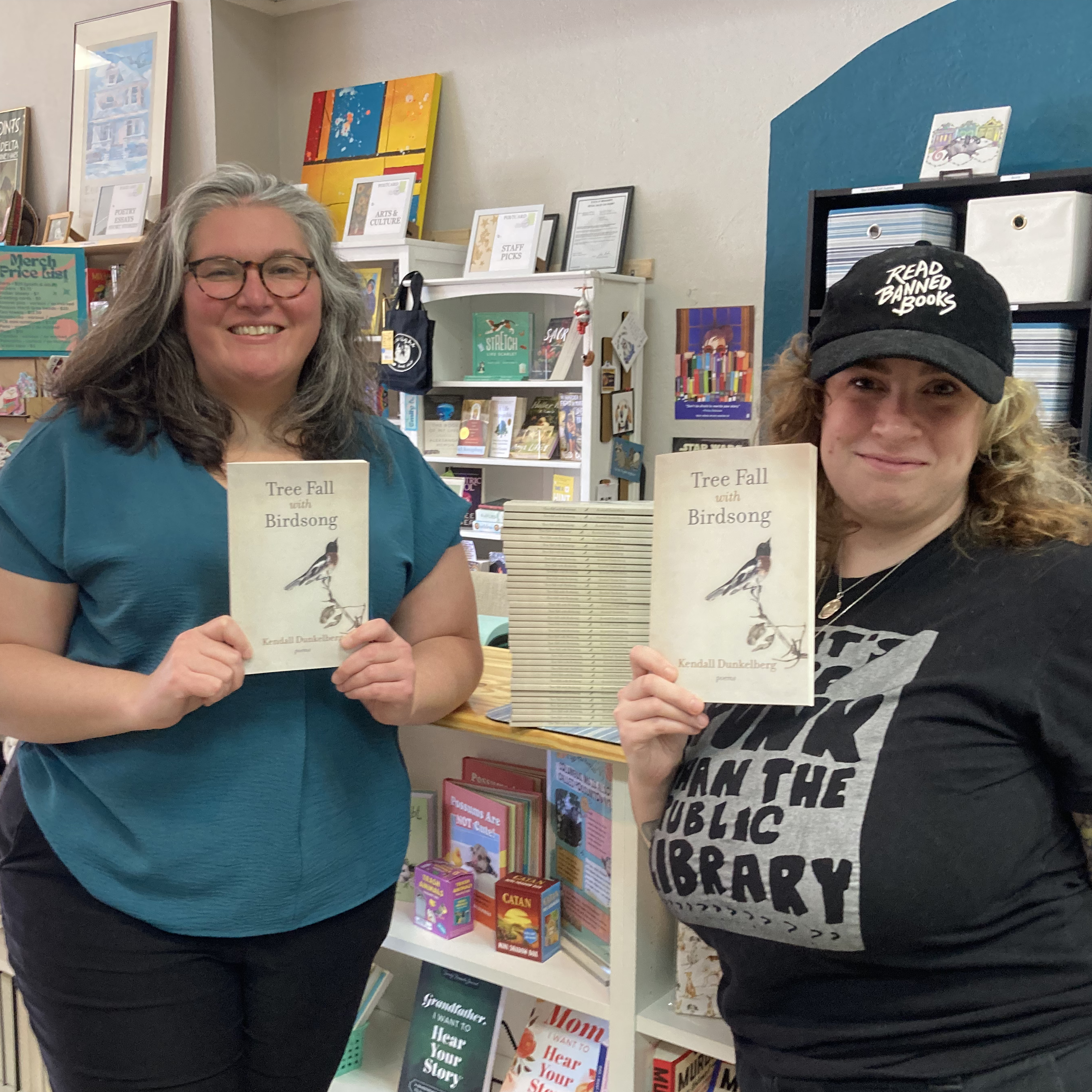
It’s been a busy pub day for Tree Fall with Birdsong, besides writing the two previous posts about the official release online today, I mailed copies to Ann Fisher-Wirth, Jacqueline Trimble, and Claude Wilkinson with thanks for their kind words that grace its cover, and I made a stop at Friendly City Books to see Emily Liner and her staff. It was great to see books actually in a store and on the shelf.

We also talked about the book launch at Friendly City on June 5, and the store’s Poetry Book Club, where I’ll be featured on July 1, and how folks will be able to buy a personalized signed copy through the store — look for more news about a link to request this soon!

It’s so great to have a dedicated local bookstore who is willing to get behind authors and help them promote their work. I’d like support the store by funneling as many sales directly through them as possible, though sales through Bookshop.org can also benefit Friendly City or your local independent bookstore, and I’m excited to schedule readings at other stores around Mississippi, Iowa, and further afield, both to engage with readers in person and to support local stores, libraries, and schools. Anytime I can coordinate with a bookstore and a library, high school, community college, or university to organize a reading, I’ll be thrilled.

The other thing I’ve done today was spend more time than usual on social media, posting about what I’m doing, including a post on my Substack. The gratifying part of that has been reading the comments on some of my posts. The other gratifying part was seeing good news from other people, including our MFA students and faculty, and Friendly City Books, who recently announced they will hold a 2nd Annual Possum Town Book Festival on August 16, 2025, and liking, sharing, and reposting.

It’s been a busy day, and a very rewarding day.

Happy Pub Day, Part 2

To celebrate the official release of Tree Fall with Birdsong, I want to take a moment to look back with my readers on how this book came to be. It has been a long time in the making; I started writing poems for this collection even before I published my second book, Time Capsules. As I was nearing completion of that book, I realized there were poems that were heading in a new direction and wouldn’t really fit with the others. This happens anytime I’m sorting and ordering poems for a collection. It was also somewhat influenced by Paul Ruffin who had asked me to send him about 80 poems for Time Capsules. Some of the poems I had at the time just didn’t fit, and while I knew some of those might not end up in any collection, others could form the germ of something new. Most of these found their way into the first section of Tree Fall with Birdsong, including the title poem of that section, “Birdsong.” There were also a few other poems that initially got culled, but that I eventually went back to and reevaluated as I was making final decisions about Tree Fall with Birdsong.

I might have finished this collection sooner, but I had also started writing the first poems for Barrier Island Suite, and for a while I felt like I was in a competition between two collections to see which would become a book first. When I realized I needed to write about Walter Anderson’s life on shore, I saw the way to round out Barrier Island Suite, and thanks to the research and reading I had already done, that collection sprinted over the finish line while I was still steadily writing poems for my other project, the first working title of which was “Breathe and Other Poems,” since the poem “Breathe” was initially the title poem and organizing principle of the collection.

Time happened, as did a search of book titles on Amazon that revealed there are several, maybe hundreds, of poetry collections with the title Breathe or something similar. I was hardly surprised, but it had been a good working title for several years. By that point, I had written the poems that are now the penultimate section of the book, “Tree Fall.” Initially, this was two sections: “The Orchard” and “The Big Maple.” These became the new heart of the collection and eventually I saw the wisdom of combining them and making that section the title section of the book. Before my working title became “Tree Fall,” the collection had briefly been submitted with the title “A Necessary Lie,” though I quickly realized that there were nearly as many books with that title as “Breathe.” But that title led me to the title “Tree Fall” for which I could only find one other instance, which turned out to be a very cool statue by a California artist that came up in a search once, though I can’t find it anymore.

I wasn’t worried about any competition from an obscure statue, but I did wonder whether “Tree Fall” would be enough of a title and whether it truly encompassed the whole collection. For me, “Tree Fall” represents the idea of loss, whether that is in the poems dedicated to trees we have lost or to my sister who died of cancer, to my father-in-law who died of ALS, or to our neighbor who also died of cancer, or even the sense of transience and the cycle of the seasons moving into winter that was part of “Tombigbee River Haiku.” But the haiku juxtapose this sense of loss with a sense of presence, fall and winter with springtime and summer. Other poems were more about renewal, and though I had already started to include that in my book proposals, I didn’t know how to include it in the title.

By this point, Paul Ruffin at Texas Review Press had already passed away, and when I sent my manuscript to the interim director, she initially put me off until a new permanent director was in place, which took some time. Then the press told me they were more interested in going in a new direction, building up their own list of authors rather than sticking with past relationships. That’s when I started submitting the manuscript elsewhere in earnest. By then, I felt I had a full collection, and I still feel I would have had a very good book had it been published as it was. I garnered several quite positive rejections that essentially told me their press had already accepted all the poetry collections they could publish in the next couple of years. I even was accepted by a publisher, though once I read their description of terms, I realized they were not the kind of press I was looking for, and I turned them down.

Then COVID happened, and that led to the poems in the final section “Quarantine.” Though I didn’t want to write too directly about the pandemic (only a couple of poems mention it), it was also nearly impossible to avoid. For at least a couple of years, it was the main thing on everyone’s mind, and the poems in that section were ways I attempted to write myself, and to write the world, out of the collective grief we were all going through by delving into myths of the underworld and writing my way to a creation story.

The thing I have always known about the myths around Persephone, Iannana, Ishtar, Adonis, Osiris and others is that they are as much about fertility in springtime as they are about the death of the god or goddess. Yes, they are about mourning, but they are also about the hope of renewal. This reminded me that my own poems, as much as they had focused on the loss of loved ones and of the trees that fell in my mother’s yard (and implicitly about her mortality, since she was already in her nineties), they were also populated by many wildflowers and songbirds. This is what led me to add Birdsong to the title, even as the final section helped me to pull the whole collection together.

In the meantime, partly as a diversion to get myself out of the habit of writing about birds and flowers (not a bad habit to have, by the way), I started writing my “Intergalactic Traveler” poems. Once again, I knew they weren’t going to play well with the poems in Tree Fall with Birdsong, so I realized I had something new on my hands. At first I thought they might be a short series of poems, and I didn’t really know what to do with them. Now, I have more than twenty, and I’ve already moved on to write new myth poems, focusing on myths that are the names of galaxies or constellations. Will I have a chapbook and the start of a new collection or will they all play well together and form the backbone of a collection that is now about halfway to completion? Only time will tell.

But to turn back to Tree Fall with Birdsong. I couldn’t be happier with the way this book has turned out or happier with the publisher I landed with. Fernwood Press has been great to work with. The design of the cover and the interior is inspired. Eric Muhr and his team are fully behind my vision for the book, and they have been extremely conscientious and thorough in editing and marketing. I’m also thoroughly impressed with the rest of their list and already feel a kinship with their other writers, so I am very much looking forward to this next stage in my publishing journey.

I’ve already been fortunate to have an interview and featured poems in Rooted Magazine, and I have more good publicity in the works, now that review copies have gone out. I’m hoping for at least a couple more interviews, and hopefully a few book reviews over the next several weeks to months, and I will be on sabbatical in the fall, which will give me plenty of time to extend my book tour. My goal is to bring these poems to as many people and in as many ways as possible, whether that is through book sales or people coming to readings and just listening to a good poem. That’s what the writing is for, and now that Tree Fall with Birdsong is in the world that new life as a book can truly begin.

Happy Official Pub Day!

Tree Fall with Birdsong is officially published today, May 21, 2025. That means it should be in bookstores if they ordered copies initially, and Bookshop.org, Barnes & Noble, and Amzaon should have stock and begin shipping pre-orders today. Exciting!

I can’t wait to start to see this book out in the world, so I’d love to see people post about it when you get your copies (hint, hint). I’m also getting excited about some upcoming events, including the book launch reading at Friendly City Books in Columbus, Mississippi, with Lauren Rhoades, who will read from her new memoir Split the Baby, also hot off the press. Also in June, I’ll take part in an online reading for ALS Awareness, hosted by the inimitable Boa Flouncer herself, Katrina Byrd. And on July 24, I’ll be reading at Lemuria Books in Jackson, Mississippi. I’m planning to line up more readings this summer and into the fall, but still have nail down a few dates, so watch my Events page for more listings on the calendar.

When Fernwood Press and I initially talked about a release date, we had discussed May 13, but they pushed it back a week to be sure that online stories would have copies. May 13 became the date they listed the book on their site, so I treated it as a soft launch with and a first pub date mostly because I had already posted about that date before I learned, but Fernwood stuck to the May 21 date for the official release. Copies should be in the mail today regardless of where you ordered, and some may have shipped early, so maybe you’ll get yours today or very soon!

Fernwood Press was excited to see strong initial orders at Bookshop.org in the first week or so that the book was listed there and I had been promoting it here and on my socials. Thanks in advance for those who ordered a copy already! Bring them to a reading near you, and I’ll be happy to sign! Or if you live near me, let me know and I can sign some on my front porch or come to you.

Why I Bailed on a Book Deal, Part 2

On March 27, 2019, I wrote a post on this blog titled “Why I Bailed on a Book Deal.” It is the first post I have ever taken down, with my apologies to those who commented on it. In that post, I chronicled the communication I received from a publisher who had accepted my fourth poetry collection. As I learned more about their terms, I withdrew my manuscript from consideration and wrote about my rationale.

For me the sticking points were the high numbers of advance pre-orders required before a book would go to press and the fact that the royalty rates for the book were determined by the advance sales rate. As I recall, there was a provision for royalties to go higher once the book sold a certain, fairly high amount.

In my original post, I indicated that I knew some poets who had published with this press, and though I couldn’t speak to their experience, I had to surmise that the terms were worth it for them.I also knew that it wasn’t the kind of contract I wanted, and I encouraged everyone to be informed and to make their own decisions about publishing.

Today, I received an email from this company, complaining about my 6-year-old post and threatening legal action if I did not remove it, saying “The information is false and is hurting my business.  The author of this article has included information that is not correct.  [Deleted] Press does pay in royalty payments.  Your article is outdated and misleading, and has been brought to my attention by a writer who wants to publish with us.” and “Please remove the article from your site.  In the event you refuse or are unable to remove the liable content, I will seek legal action against you personally.”

I could take the high road and call their bluff, but I don’t earn any income from this blog and it would certainl cost me time and money to do so. My point in writing the post was not to malign the company but to discuss the changing world of small press publshing — there are several other publishers that blur the line between traditional publishing models and hybrid models. My point was that writers need to research prospective publishers before submitting, and even then, need to carefully read contracts and be willing to walk away if the terms aren’t right for them. This does not make the publisher a bad choice for everyone, as I wrote then, but only that is not the right fit for you.

I do not retract what I said in that post—it was accurate when I wrote it—but I also don’t need to be hassled with these kind of threats. That post has done its job. I’m adding this post to explain why it is no longer available and to reiterate the point that writers should carefully consider every publishing offer.

If the press in the original has changed their terms in the six years since I wrote the post, as they claim in their email, then I applaud them for it. But their threats of legal action tell a different story and make me that much happier that I made the decision I did at the time. Sometimes, you need to follow your gut.

For anyone who is considering a book contract, I highly recommend the Model Trade Contract published by the Author’s Guild and other contract resources and their advice on avoiding publishing scams. Other resources such as Writer Beware can also be helpful.

As I said in my last comment, I am very happy with my current publisher. They worked with me to include some language from the Author’s Guild Model Contract that made sense for them and for me, and they have been very open with me every step of the way. We have an excellent working relationship, and that is the main thing I’m looking for when I agree to publish with a press.

Please don’t ask me who the publisher in that original post was. I no longer feel comfortable naming them. All I will say is that it was not any press I have published with in the past, nor do I ever plan to work with them in the future.