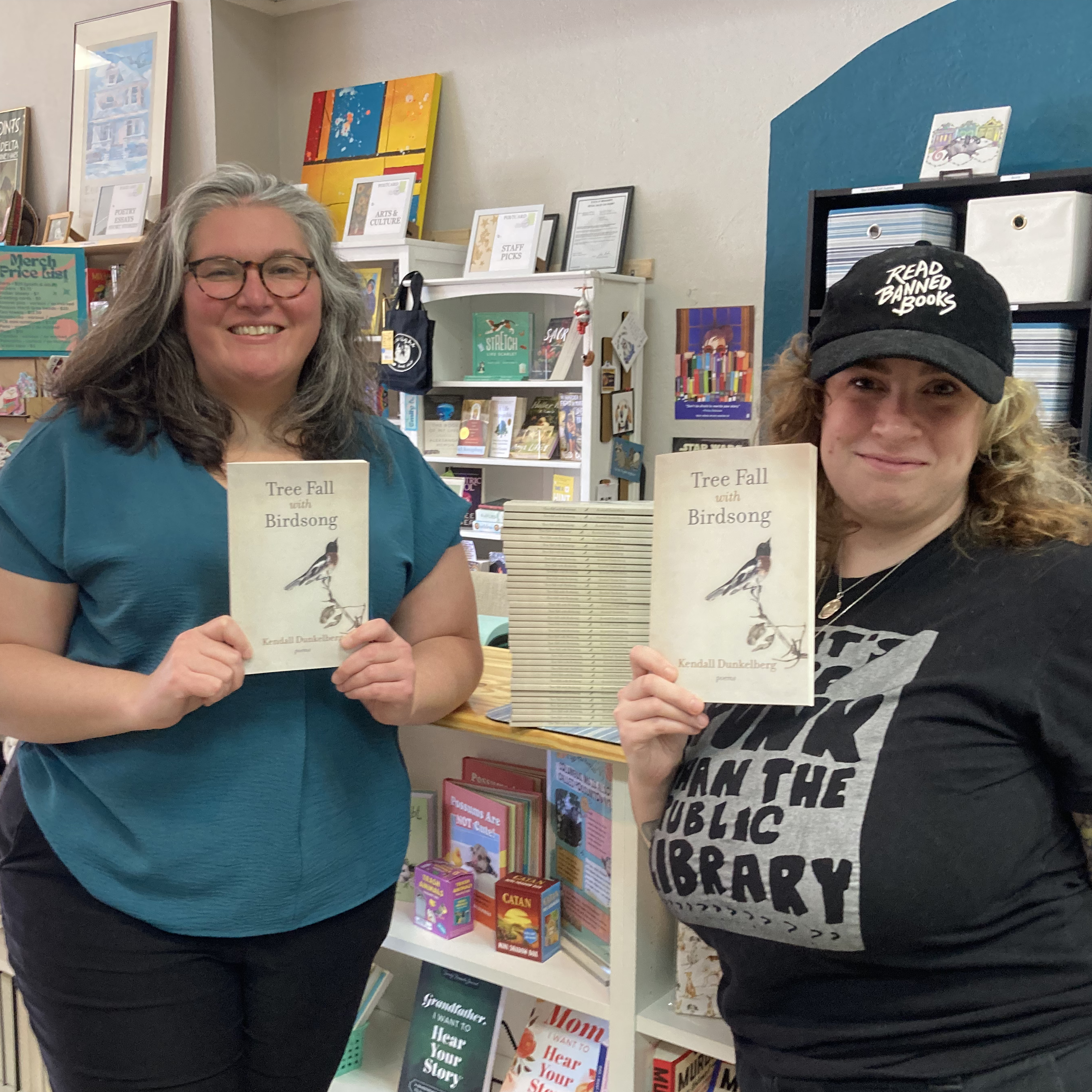
It’s been a busy pub day for Tree Fall with Birdsong, besides writing the two previous posts about the official release online today, I mailed copies to Ann Fisher-Wirth, Jacqueline Trimble, and Claude Wilkinson with thanks for their kind words that grace its cover, and I made a stop at Friendly City Books to see Emily Liner and her staff. It was great to see books actually in a store and on the shelf.
We also talked about the book launch at Friendly City on June 5, and the store’s Poetry Book Club, where I’ll be featured on July 1, and how folks will be able to buy a personalized signed copy through the store — look for more news about a link to request this soon!
It’s so great to have a dedicated local bookstore who is willing to get behind authors and help them promote their work. I’d like support the store by funneling as many sales directly through them as possible, though sales through Bookshop.org can also benefit Friendly City or your local independent bookstore, and I’m excited to schedule readings at other stores around Mississippi, Iowa, and further afield, both to engage with readers in person and to support local stores, libraries, and schools. Anytime I can coordinate with a bookstore and a library, high school, community college, or university to organize a reading, I’ll be thrilled.
The other thing I’ve done today was spend more time than usual on social media, posting about what I’m doing, including a post on my Substack. The gratifying part of that has been reading the comments on some of my posts. The other gratifying part was seeing good news from other people, including our MFA students and faculty, and Friendly City Books, who recently announced they will hold a 2nd Annual Possum Town Book Festival on August 16, 2025, and liking, sharing, and reposting.
To celebrate the official release of Tree Fall with Birdsong, I want to take a moment to look back with my readers on how this book came to be. It has been a long time in the making; I started writing poems for this collection even before I published my second book, Time Capsules. As I was nearing completion of that book, I realized there were poems that were heading in a new direction and wouldn’t really fit with the others. This happens anytime I’m sorting and ordering poems for a collection. It was also somewhat influenced by Paul Ruffin who had asked me to send him about 80 poems for Time Capsules. Some of the poems I had at the time just didn’t fit, and while I knew some of those might not end up in any collection, others could form the germ of something new. Most of these found their way into the first section of Tree Fall with Birdsong, including the title poem of that section, “Birdsong.” There were also a few other poems that initially got culled, but that I eventually went back to and reevaluated as I was making final decisions about Tree Fall with Birdsong.
I might have finished this collection sooner, but I had also started writing the first poems for Barrier Island Suite, and for a while I felt like I was in a competition between two collections to see which would become a book first. When I realized I needed to write about Walter Anderson’s life on shore, I saw the way to round out Barrier Island Suite, and thanks to the research and reading I had already done, that collection sprinted over the finish line while I was still steadily writing poems for my other project, the first working title of which was “Breathe and Other Poems,” since the poem “Breathe” was initially the title poem and organizing principle of the collection.
Time happened, as did a search of book titles on Amazon that revealed there are several, maybe hundreds, of poetry collections with the title Breathe or something similar. I was hardly surprised, but it had been a good working title for several years. By that point, I had written the poems that are now the penultimate section of the book, “Tree Fall.” Initially, this was two sections: “The Orchard” and “The Big Maple.” These became the new heart of the collection and eventually I saw the wisdom of combining them and making that section the title section of the book. Before my working title became “Tree Fall,” the collection had briefly been submitted with the title “A Necessary Lie,” though I quickly realized that there were nearly as many books with that title as “Breathe.” But that title led me to the title “Tree Fall” for which I could only find one other instance, which turned out to be a very cool statue by a California artist that came up in a search once, though I can’t find it anymore.
I wasn’t worried about any competition from an obscure statue, but I did wonder whether “Tree Fall” would be enough of a title and whether it truly encompassed the whole collection. For me, “Tree Fall” represents the idea of loss, whether that is in the poems dedicated to trees we have lost or to my sister who died of cancer, to my father-in-law who died of ALS, or to our neighbor who also died of cancer, or even the sense of transience and the cycle of the seasons moving into winter that was part of “Tombigbee River Haiku.” But the haiku juxtapose this sense of loss with a sense of presence, fall and winter with springtime and summer. Other poems were more about renewal, and though I had already started to include that in my book proposals, I didn’t know how to include it in the title.
By this point, Paul Ruffin at Texas Review Press had already passed away, and when I sent my manuscript to the interim director, she initially put me off until a new permanent director was in place, which took some time. Then the press told me they were more interested in going in a new direction, building up their own list of authors rather than sticking with past relationships. That’s when I started submitting the manuscript elsewhere in earnest. By then, I felt I had a full collection, and I still feel I would have had a very good book had it been published as it was. I garnered several quite positive rejections that essentially told me their press had already accepted all the poetry collections they could publish in the next couple of years. I even was accepted by a publisher, though once I read their description of terms, I realized they were not the kind of press I was looking for, and I turned them down.
Then COVID happened, and that led to the poems in the final section “Quarantine.” Though I didn’t want to write too directly about the pandemic (only a couple of poems mention it), it was also nearly impossible to avoid. For at least a couple of years, it was the main thing on everyone’s mind, and the poems in that section were ways I attempted to write myself, and to write the world, out of the collective grief we were all going through by delving into myths of the underworld and writing my way to a creation story.
The thing I have always known about the myths around Persephone, Iannana, Ishtar, Adonis, Osiris and others is that they are as much about fertility in springtime as they are about the death of the god or goddess. Yes, they are about mourning, but they are also about the hope of renewal. This reminded me that my own poems, as much as they had focused on the loss of loved ones and of the trees that fell in my mother’s yard (and implicitly about her mortality, since she was already in her nineties), they were also populated by many wildflowers and songbirds. This is what led me to add Birdsong to the title, even as the final section helped me to pull the whole collection together.
In the meantime, partly as a diversion to get myself out of the habit of writing about birds and flowers (not a bad habit to have, by the way), I started writing my “Intergalactic Traveler” poems. Once again, I knew they weren’t going to play well with the poems in Tree Fall with Birdsong, so I realized I had something new on my hands. At first I thought they might be a short series of poems, and I didn’t really know what to do with them. Now, I have more than twenty, and I’ve already moved on to write new myth poems, focusing on myths that are the names of galaxies or constellations. Will I have a chapbook and the start of a new collection or will they all play well together and form the backbone of a collection that is now about halfway to completion? Only time will tell.
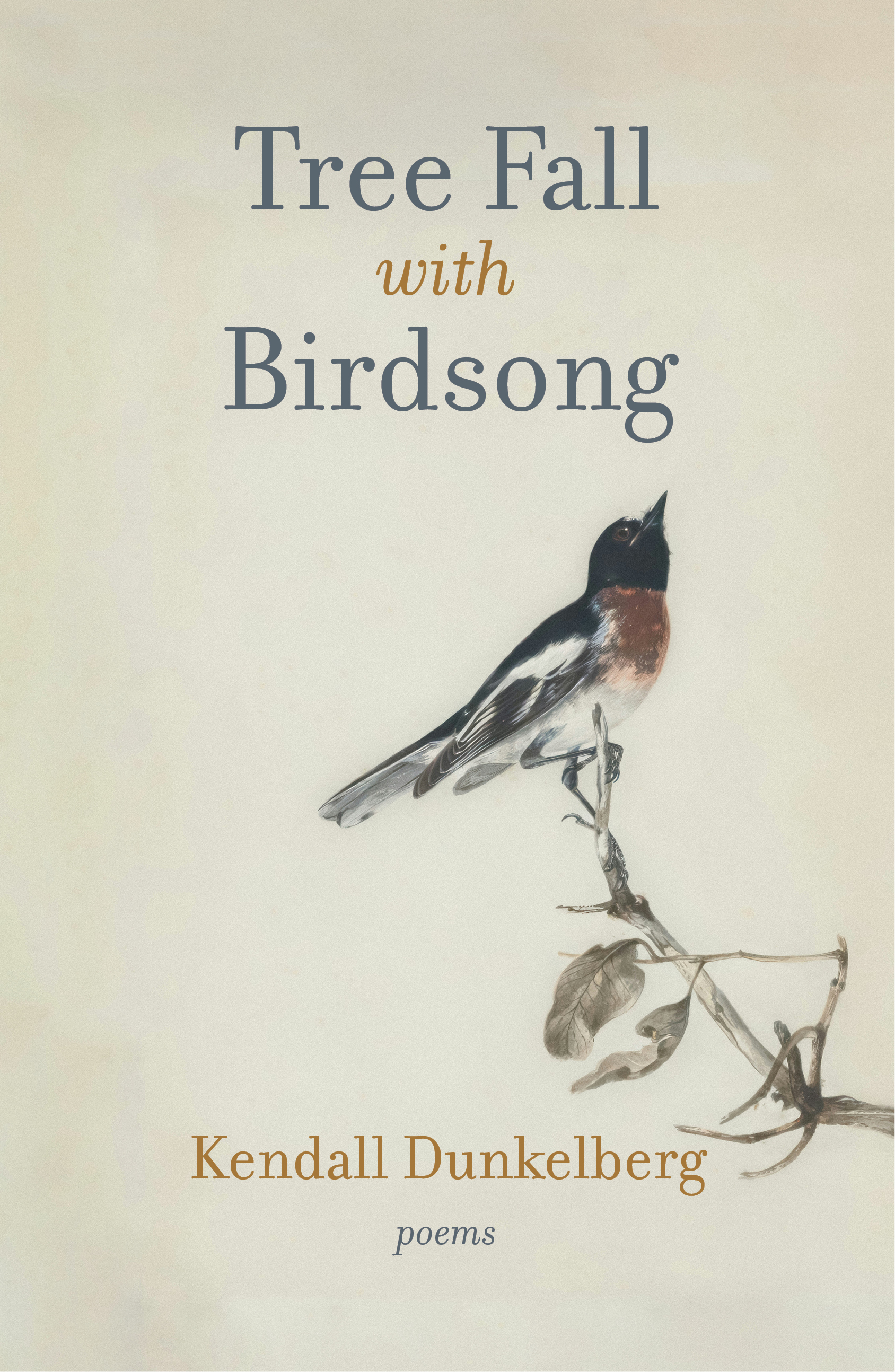
But to turn back to Tree Fall with Birdsong. I couldn’t be happier with the way this book has turned out or happier with the publisher I landed with. Fernwood Press has been great to work with. The design of the cover and the interior is inspired. Eric Muhr and his team are fully behind my vision for the book, and they have been extremely conscientious and thorough in editing and marketing. I’m also thoroughly impressed with the rest of their list and already feel a kinship with their other writers, so I am very much looking forward to this next stage in my publishing journey.
I’ve already been fortunate to have an interview and featured poems in Rooted Magazine, and I have more good publicity in the works, now that review copies have gone out. I’m hoping for at least a couple more interviews, and hopefully a few book reviews over the next several weeks to months, and I will be on sabbatical in the fall, which will give me plenty of time to extend my book tour. My goal is to bring these poems to as many people and in as many ways as possible, whether that is through book sales or people coming to readings and just listening to a good poem. That’s what the writing is for, and now that Tree Fall with Birdsong is in the world that new life as a book can truly begin.
Tree Fall with Birdsong is officially published today, May 21, 2025. That means it should be in bookstores if they ordered copies initially, and Bookshop.org, Barnes & Noble, and Amzaon should have stock and begin shipping pre-orders today. Exciting!
I can’t wait to start to see this book out in the world, so I’d love to see people post about it when you get your copies (hint, hint). I’m also getting excited about some upcoming events, including the book launch reading at Friendly City Books in Columbus, Mississippi, with Lauren Rhoades, who will read from her new memoir Split the Baby, also hot off the press. Also in June, I’ll take part in an online reading for ALS Awareness, hosted by the inimitable Boa Flouncer herself, Katrina Byrd. And on July 24, I’ll be reading at Lemuria Books in Jackson, Mississippi. I’m planning to line up more readings this summer and into the fall, but still have nail down a few dates, so watch my Events page for more listings on the calendar.
When Fernwood Press and I initially talked about a release date, we had discussed May 13, but they pushed it back a week to be sure that online stories would have copies. May 13 became the date they listed the book on their site, so I treated it as a soft launch with and a first pub date mostly because I had already posted about that date before I learned, but Fernwood stuck to the May 21 date for the official release. Copies should be in the mail today regardless of where you ordered, and some may have shipped early, so maybe you’ll get yours today or very soon!
Fernwood Press was excited to see strong initial orders at Bookshop.org in the first week or so that the book was listed there and I had been promoting it here and on my socials. Thanks in advance for those who ordered a copy already! Bring them to a reading near you, and I’ll be happy to sign! Or if you live near me, let me know and I can sign some on my front porch or come to you.
On March 27, 2019, I wrote a post on this blog titled “Why I Bailed on a Book Deal.” It is the first post I have ever taken down, with my apologies to those who commented on it. In that post, I chronicled the communication I received from a publisher who had accepted my fourth poetry collection. As I learned more about their terms, I withdrew my manuscript from consideration and wrote about my rationale.
For me the sticking points were the high numbers of advance pre-orders required before a book would go to press and the fact that the royalty rates for the book were determined by the advance sales rate. As I recall, there was a provision for royalties to go higher once the book sold a certain, fairly high amount.
In my original post, I indicated that I knew some poets who had published with this press, and though I couldn’t speak to their experience, I had to surmise that the terms were worth it for them.I also knew that it wasn’t the kind of contract I wanted, and I encouraged everyone to be informed and to make their own decisions about publishing.
Today, I received an email from this company, complaining about my 6-year-old post and threatening legal action if I did not remove it, saying “The information is false and is hurting my business. The author of this article has included information that is not correct. [Deleted] Press does pay in royalty payments. Your article is outdated and misleading, and has been brought to my attention by a writer who wants to publish with us.” and “Please remove the article from your site. In the event you refuse or are unable to remove the liable content, I will seek legal action against you personally.”
I could take the high road and call their bluff, but I don’t earn any income from this blog and it would certainl cost me time and money to do so. My point in writing the post was not to malign the company but to discuss the changing world of small press publshing — there are several other publishers that blur the line between traditional publishing models and hybrid models. My point was that writers need to research prospective publishers before submitting, and even then, need to carefully read contracts and be willing to walk away if the terms aren’t right for them. This does not make the publisher a bad choice for everyone, as I wrote then, but only that is not the right fit for you.
I do not retract what I said in that post—it was accurate when I wrote it—but I also don’t need to be hassled with these kind of threats. That post has done its job. I’m adding this post to explain why it is no longer available and to reiterate the point that writers should carefully consider every publishing offer.
If the press in the original has changed their terms in the six years since I wrote the post, as they claim in their email, then I applaud them for it. But their threats of legal action tell a different story and make me that much happier that I made the decision I did at the time. Sometimes, you need to follow your gut.
As I said in my last comment, I am very happy with my current publisher. They worked with me to include some language from the Author’s Guild Model Contract that made sense for them and for me, and they have been very open with me every step of the way. We have an excellent working relationship, and that is the main thing I’m looking for when I agree to publish with a press.
Please don’t ask me who the publisher in that original post was. I no longer feel comfortable naming them. All I will say is that it was not any press I have published with in the past, nor do I ever plan to work with them in the future.
Today is a big day in the life of Tree Fall with Birdsong. Yesterday was the official launch at Fernwood Press, which meant my book page went live on their site, and as of today, the “purchase” links were active in their online store. Order your copy today! You’ll see that purchasing goes through the parent company, Barclay Press. I’ve updated my book page with the link, and of course have been posting about it, including a SubStack post, which I won’t duplicate here.
The other big news is that an interview I did for Rooted Magazine was published this morning. It’s wonderful of Lauren Rhoades to feature me and let me talk about my book, and the timing couldn’t be better. Review copies go out to reviewers this week, too, and I’m busing lining up some more publicity this way. Look for another interview sometime this summer, and more news on bookstore readings and other events. So far, I’ve scheduled June 5 at Friendly City Books and July 24 at Lemuria Books. Since I’ll be on sabbatical in the fall, I’ll be looking to travel around Mississippi and beyond, so I’m hoping to book a quite a few readings at bookstores, libraries, and colleges.
Yesterday, I posted my first unboxing video to social media. I found the whole process a little weird, but also exciting, obviously, since I was opening my box of author copies that my publisher had sent. I should say, 10 are free author copies and the rest were happily bought at my author discount so I’ll have some to give away and to sell at events where I can’t work with a bookstore.
You’ll notice from the package label, if you can make it out, that the books were shipped from Barclay Press. That’s the parent company of my publisher Fernwood Press, which focuses on poetry. Barclay Press is a Quaker press, and publishes mostly nonfiction, as I understand it. My publisher, Eric Muhr, works with both.
The only thing unnerving about the unboxing was recording video with my phone with one hand while using the box cutter to open the box with the other and also narrating what I was doing. I guess I can walk, talk, and chew gum at the same time, sort of, though I don’t know if I was terribly eloquent while doing so or perfect with my camera work. If raw and unscripted is the vibe you should be going for in an unboxing video, then I guess I got that right.
The exciting part was seeing my books in the flesh for the first time. That is a moment every author savors. All the work of many years, including the multiple revisions — in this book’s case, revisions brought on both by submitting to publishers through multiple rounds and by the events that took place in the intervening years, including the loss of my mother this year — has finally come to fruition.
As exciting as it is to see a book, though, it is even more exciting to hold it in your hand, to feel the heft of its 106 pages, and to feel the texture of the cover and the pages as you flip through them. It’s not like I have to read each page to know what is in the book; I’ve reread it multiple times in recent days when proofreading, and of course I’ve read every poem many, many times while working through revisions.
I have to thank Fernwood Press for the remarkable job they’ve done with the book’s design. They are incredibly thoughtful and creative, and I couldn’t be happier with my choice of publisher and their choice of me as a poet to add to their list. It’s been fabulous working with them so far, and I look forward to working with them throughout the life of this book.
If anyone wants to watch the video, here it is from Instagram. If there is a criticism of my technique, it is probably that the only part of me that gets in the frame are my hands (or left hand, actually). That may be for the best, though. For now, let the the focus be on the book.
As we inch towards the release date for Tree Fall with Birdsong (May 13 from Fernwood Press’s website and May 21 from bookstores), I’ve been updating this site to add a new page for the book. I will have information on how to order directly from the publisher as soon as that’s available, and I’ve already been able to add links for pre-orders at Bookshop.org and Barnes & Noble. I’ve also seen the book listed at Amazon and Walmar, and even at Saxon, a bookstore in Copenhagen. I’ll let people search for it there and instead promote shopping at your local store through Bookshop or at least ordering through your local chain store (Barnes & Noble or Books-a-Million).
If you’re looking for a good, local place to purchase and you don’t have a store near you, please consider Friendly City Books, Square Books, Lemuria, or The Author Shoppe. I have a first reading set up for Friendly City Books on June 5 and am working scheduling readings around Mississippi, North Iowa, and elsewhere.
If you would like to bring me to your book club, library, community college, university, or just about anywhere else, drop me a line. I will be on sabbatical for Fall 2025, and am happy to travel.
As I gear up for the releast of my new poetry collection, Tree Fall with Birdsong, I’m trying out Square as a way to accept credit cards. So far, it’s going great.
Let me back up and explain. It’s been awhile since I’ve been on a self-promotional book tour, and when I’ve done readings recently, it’s usually been in conjunction with a bookstore so I don’t have to worry about sales. But this month, I was invited to give a reading at Jackson State Community College and asked to bring my own books. I was happy to do so, especially since I’m hoping to have more opportunities like this once Tree Fall with Birdsong is released next month.
My one concern about selling books on my own, I might need to be able to take credit cards. In the past when I sold books, cash and checks were still more common, but these days, I wasn’t so sure. After looking around at different options, I landed on Square, mostly because of their fee structure. I will pay for every transaction, but the cost is worth it. What they don’t require is a monthly fee or minimum to be on Square. Because my personal book sales are likely to be sporadic, this is essential. My sales volume will be low enough that a monthly fee would almost certainly wipe out any profit I could make, but with this pricing structure, I only get charged when I make a sale.
There is a Plus plan that costs $29.99 per month, and I’m sure it is worth it for businesses of a certain size, but for my needs it would be overkill. They gave me a month’s free trial, which I’ve canceled.
Setting up Square was relatively painless. I was able to add three books, enter a starting inventory quantity and prices. I even added a couple of discounts so I could quickly sell two or three titles at a discounted rate. And because my iPhone SE 2nd Gen is able to take contactless payments, I was able to start taking payments without any additional equipment, which turned out to be essential.
The one issue I had was that they sent me the wrong type of stripe reader initially. They send the USB-C version, and I needed the lightning version. We got that corrected, so now I have the right one, but it didn’t arrive in time for the reading. Nonetheless, I was still able to take contactless payments with just my phone.
The reading was great. We had a small, attentive crowd, and several people bought books. Most came with cash, so maybe all my preparation was for nought, but one person did pay with a card, and that went through without a hitch. I charged him $15 for the sale, and in a day or two, the money appeared in my bank account, minus about 50¢ for the processing fee and Square transaction fee. And now I know it works, so the next time I need to sell books on my own, I’ll be ready. If I do encounter someone who can’t do contactless payments, I’ll even have a stripe reader, as long as I don’t forget to bring it with me.
As an added benefit, I could start taking payments for books online and sell from home. I’m not sure I want to mess with that, since it would also mean mailing them, but it would be an option if I get ambitious. And if no one buys online (or if they do infrequently), I still won’t have a monthly fee, so I won’t be out any money unless I actually make a sale. For that reason alone, I highly recommend Square for anyone who wants to occasionally take credit card payments.
How many of you already have an author website? Jane Friedman brought this up in her Electric Speed newsletter, which gave me the impetus to write about it to my MFA student, and I thought I’d add a little more here. Friedman linked to her article that encourages even unpublished authors to start a site and gives tips on what to include.
Jane Friedman wrote The Business of Being a Writer, and I got to meet her at AWP once in Tampa (briefly) when my student Katrina Byrd interned with her and blogged about AWP. Katrina even included me in one of her blog posts for Friedman. So now I’m famous, or I’ve had my 15 minutes of fame, anyway.
If you write and haven’t started an author website yet, now might be the time. If you have started one, now might be a good time to give it a fresh coat of paint, or at least give it another look to see if there’s anything you want to add or change. Friedman gives some great advice in an encouraging way, and she sets expectations low for new authors. It’s about getting started and getting used to presenting yourself publicly while no one is watching (or very few people are).
I was glad to see that she recommended the strategy I chose for my site several years ago of moving the author blog to a separate area of the site and making the site’s landing page a more static information page. I also liked her thoughts on keeping that first page limited to a brief introduction, inviting readers to dig deeper on pages like an “About” or “Bio” or “Books” page. And her overall tone suggests that an author page should reflect the writer’s personality — there isn’t one template the will be right for everyone, though following some best practices is wise.
One point she doesn’t make that I often hear is that it doesn’t hurt to snag your domain name before someone else does. If you don’t have your own yet, you might want to consider it. That might be your next step once you get your site up and running. WordPress and probably other site building services can help you with domain registry when you’re ready to do it, though some people would argue for purchasing your domain as the very first step. Owning a domain costs a little more, certainly more than WordPress’s free mode, but it can be worth it to establish your online identity before you commit to the design of your site. It would be a shame to have to change a lot about your site just because you couldn’t get the name you wanted.
Another thing this article did remind me about, though, is that even static pages need occasional updates. One mistake I see from a lot of authors is that they create an author site and 5hen let it languish with infrequent attention. I get it. It takes time and effort. I manage a few websites (my own and a few at my university), and sometimes there can be at least a corner or two that have developed a few cobwebs from lack of attention. It’s good to plan time periodically for a little spring cleaning, even if that’s just taking down old information and replacing it with something new.
Updates I’m planning for this site include and updated Author photo. I’m not planning to be like Dear Abby and keep the same photo for decades. I’m a real person, after all. And the major update will be the addition of my newest book, Tree Fall with Birdsong. I’m just waiting on the cover reveal so I can add that. I also need to add two recent anthologies to my books page: Southern Voices: Fifty Contemporary Poets and Attached to the Living World: A New Ecopoetry Anthology. I’ve blogged about both, and having a blog is a great way to keep the site current, even if I don’t post as regularly as I used to. But it’s important to gradually move news off the blog onto more static and permanent pages of the site as well.
This just goes to show that you never know the impact of what you put online or when it might be relevant to someone again. Recently, I was contacted for help with Supercard export, thanks to a blog post I wrote nearly five years ago, back in September 2020.
At the time, I was exporting all of my data from Supercard to “comma separated value” (csv) files, so I could open those in a spreadsheet and then transfer them to a database table in OpenOffice. (I’ve since moved to LibreOffice, but they use the same formats and are essentially different flavors of the same program.) I wrote about the process because I was doing it and writing about it helped me think through what I needed to do, but I didn’t really think that anyone would be able to use it. How many people were using Supercard the way I did, and how many of those would want to move to a different platform?
Four and a half years later, I got an email out of the blue from Miki, a translator who was doing just that. They had started in Hypercard just like I did and migrated to Supercard when Hypercard was discontinued. They had what seems like a huge database of terms related to their translations. I was impressed with the way they described their Supercard stack and what they had been able to build. There was just one problem. Like me, they were working on moving to LiveCode and had hired a consultant to make the transition, but they were having issues exporting their massive amount of data in a usable form.
Miki had found my post, where I had included a screenshot of a snippet of code from my export script. They thought it looked promising, but wondered if I could elaborate. Of course, the reason I left Supercard behind was because of an OS upgrade that made it no longer work on my Mac. So I couldn’t open my projects, and hadn’t saved the full code of my export button to a text file, since I wouldn’t need it once I was done with it. I decided to send the project to Miki, and they were able to open it, share it with their consultant, and after a few email exchanges where I explained what I remembered of my strategy (after seeing the script they were able to send back to me), the consultant wrote a very simple and elegant script to export the data.
I trust they also have a strategy for bringing that data into LiveCode. As I explained to them, part of why my script was complicated was that I was trying to set up spreadsheets that would then work as tables in the relational database. I went from Supercard that acted a little like a database to one that had to actually be organized like one.
That wasn’t hard, but it did mean extracting data a few different ways. For each Place I had submitted my work, I had recorded titles, dates, and responses. For each Title I submitted, I had recorded places, dates, and responses. From that, I had to extract the data to create a table of Submissions. Each submission record would then contain the title, the place, the date, and the status (in/out/accepted/returned). I also had separate stacks for Publishers and Contests, and I wanted to combine those into one table of all Places no matter what type of place they were. I also exported a separate file with the inforation about each Place, but without the information about submissions. And I epxorted a separate file with information about each title that didn’t include the submissions.
There were a number of other things I wanted to change as I made the move from Supercard to a database, and all of that made the export a bit more complicated because I was building out three forms: Submissions, Places, and Titles. I had put all of these actions into one script so that when I flipped the switch, I could get all the data from all of my stacks all at once, creating a snapshop of all my submissions at a single moment in time.
But the main thing that Miki needed help with was how to write data from Supercard to a text file and how to organize that text file in a way that would work for their import. My original script helped with figuring out the Supertalk scripting language for this kind of operation, and I hope my explanation of what I did in the script and why I did it helped them decide what would work for their needs.
I am happy if I helped another translator and glad to be reminded of my old Supercard scripting days. Who knows, maybe it will come in handy again some day. So I don’t lose track of it, I saved the script as a pdf file so I could link to it from this post.



 Kendall Dunkelberg