International Writing in the South

In my day job, I teach World Literature, among other things, so I was excited this year to direct the Eudora Welty Writers’ Symposium and include a number of international writers. The Symposium normally focuses on Southern writers, so I tried to find writers who had been living and writing in the South for quite awhile, and to find Southern writers whose international experiences had been influential. And of course, I invited a few other transplants who are Americans new to the South or Southerners who’ve lived outside the South.

The group that came together was a lot of fun. Everyone had good experiences in the South to share, and everyone had challenges. I was glad that Judith Ortiz Cofer, in her keynote address, talked and read a poem about the ‘invisible’ migrant workers who have become a bigger part of Southern life. There always have been migrant workers, of course, but now more and more of them are Latino, and it is important to acknowledge that the culture of the region is changing.

Arab-American writer, Pauline Kaldas; African (now Mississippi) writer, Sefi Atta; Chinese (now Mississippi) poet, John Zheng; and Indian (now Texas) writer Latha Viswanathan reminded us just how international the South has become. Ethnic communities exist, not just in the big cities, but also in small towns like Columbus — our audience included a broad range of cultures, too, in part because the Mississippi School for Math and Science brought its students, too.

It was good for those students (and us) to be reminded that their communities have a voice in Southern culture (and by extension in American culture). The South is no longer a monolithic society with one majority and one minority. Soon there will be no clear majority group at all, once the largest group has less than 50% of the total population. Working together and understanding each other will become that much more important.

Ann Fisher-Wirth and Michael Smith reminded us that international experiences have always been important for writers. And Michael Kardos, Minrose Gwin, Joy Castro, and Randall Horton represented the range of cultures within the South.

All in all the weekend was a stimulating and throught-provoking experience And we all had a lot of fun.

Welty Symposium 2011 Begins

One of my favorite parts of my day job is directing the Eudora Welty Writers’ Symposium. Each year we bring a dozen authors to campus, and tonight I had dinner with our first to arrive, Joy Castro, author of The Truth Book. We had a delightful conversation, and in typical Columbus style, ran into newspaper publisher and fellow Southsider, Birney Imes, at the Thai restaurant. We talked about literature, teaching, colleges, writing, Columbus, the W, Nebraska, you name it. And of course, we talked some about what she could expect over the next few days.

Joy came in early as our Common Reading Initiative author. All of our freshmen read her memoir, The Truth Book, in their Introduction to College class, and she’ll be meeting with honors students and the CRI students at a couple of sessions. She’ll also meet with a Human Sexuality class that read her book, and then she’ll get to participate in the full symposium when that really gets underway on Thursday.

It’s always nice to meet the authors and get to spend a little time with them before the events really get started. Of course, I have lots of details to attend to (checking on books that haven’t arrived, making sure everything is okay for the auditorium, printing out maps and instructions for the authors, getting the books where they need to go, etc., etc.). There’s a lot of organizing that goes on behind the scenes, and I hope it goes off as seamlessly as possible, so no one really notices all the effort behind the scenes.

That’s the way it should be. We try to make the authors as comfortable and happy as possible, then let them read and entertain. We try to reach as many potential audience members as possible and let them come and be entertained. It’s kind of like being the cruise director on a ship. If you’re successful, you’re practically anonymous. And if people remember you, it’s probably because you messed up! So here’s to anonymity and a very successful few days. The authors that have graciously agreed to come read and talk about their work are all fabulous. The audience is great and deserves to enjoy some great literature. Soon, if it hasn’t been done already, it won’t get done, and I’ll be able to sit back and enjoy the readings, too. As long as the sound system works and there aren’t any minor crises to deal with (which there always are). Still, I wouldn’t have it any other way.

In Memoriam: Sam Moon

One of my favorite teachers and mentors passed away this month. Sam Moon of Knox College was 89. I knew him, when I first came to Knox, as the founder (with Robin Metz) of the creative writing program. He let me in my first poetry workshop (though I didn’t have the prerequisite) and taught me Poetry Translation (though the class overlapped with an Introduction to Fiction Writing class that I also needed to take). After his retirement, he worked with me on an independent study in translation. His thoughts on poetry, on language, and on life were highly influential.

An avid swimmer, Sam was working on a long, fragmentary, meditative poem on swimming when I knew him. He was also at work on a translation of the Tao Te Ching, the last I knew. I was glad to see him any time I was back at Knox, as long as he still remained in Galesburg. After he moved away and I moved further away and couldn’t return to my alma mater as frequently, we lost touch, except for a few letters and emails. And yet, Sam has often been in my mind as a role model of a poet, a teacher, and a human being. So I was not surprised, when the Knox College article about his passing quoted the style manual he wrote for the school in 1962.

Moon described style as “an unending process” aimed at achieving wisdom.
Style is a ubiquitous fact of life. No man escapes working in one medium or another. No man avoids forming attitudes and values. No man is without some kind of style. No man lacks a mask — a public face — worthy or unworthy of his possibilities. We must discriminate in these matters. We must ask ourselves what we can do, where we can go with the styles we have…

While it would be disastrous for us to embrace our culture wholly and uncritically, it would be equally disastrous for us to cut ourselves adrift from it…

In that unending process which is style, the ultimate goal, attained only rarely, by men of the greatest genius but the goal toward which we all may struggle, is the style of wisdom.

— Samuel Moon, Mortar Board Convocation, Knox College, March 1962

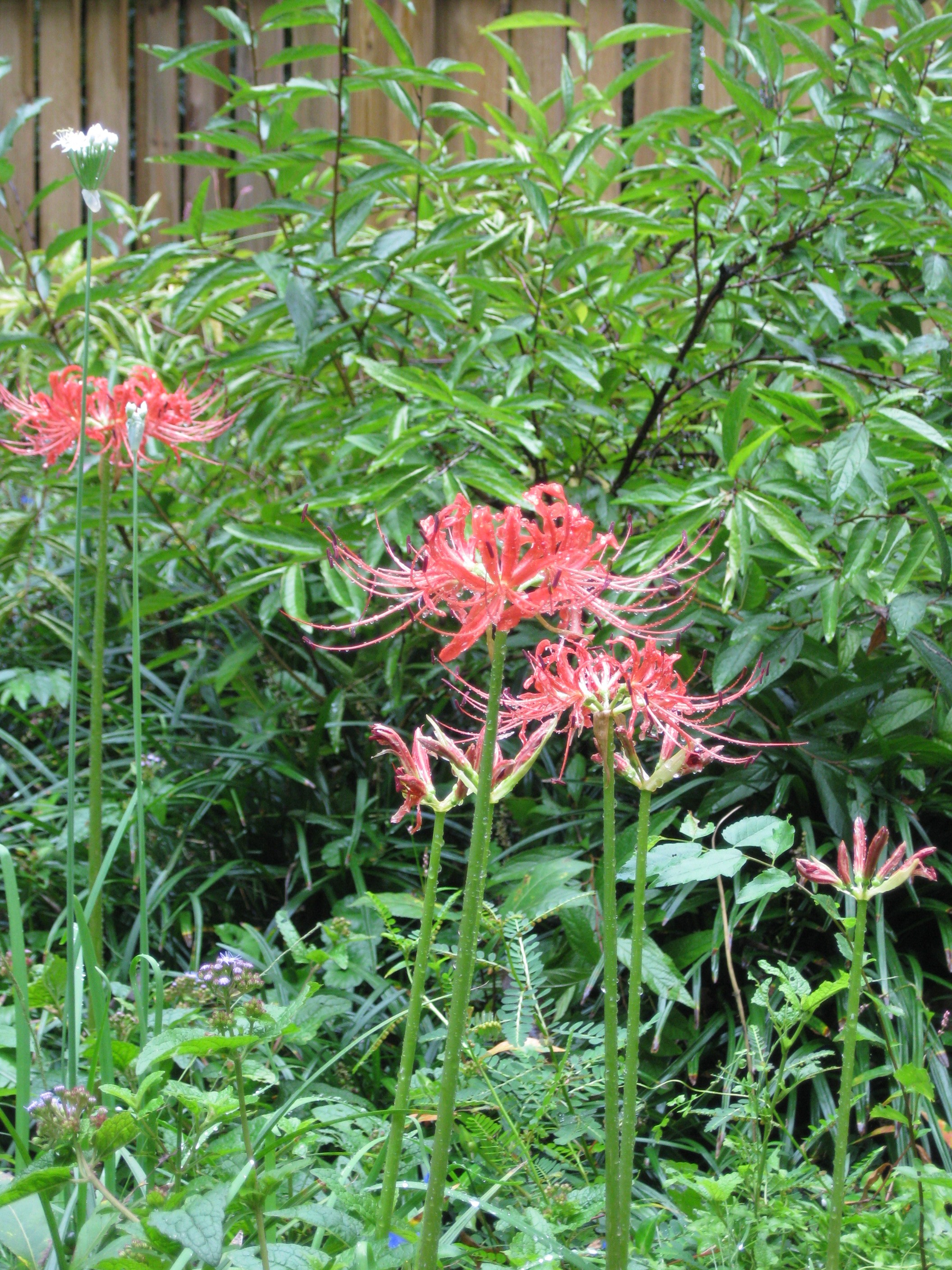
Spider Lilies

I’ve always loved the fall, maybe because my birthday is in September. But in Mississippi, it’s hard not to love a season that finally means an end to weather in the 90’s and high humidity. Usually around mid-September we start to get cold fronts coming through, and the temps don’t rise quite as high after they’re gone. You can’t really say there’s a chill in the air (as I remember from growing up in Iowa, looking forward to the first frost).

Here, one sign that fall has really come is the return of the Spider Lilies. They pop up, usually right around my birthday, though this year they seem to be a little later than usual, probably be cause it’s been so dry. I always try to notice when they appear–even before they bloom, you can see a slender stalk growing from the grass (or wherever they appear).

The general term for this type of lily that comes up in late summer is the Surprise Lily, which is the title I gave a poem in my last book, Time Capsules. I was really thinking of the Spider Lily, but some people call them by the general term and others call them Hurricane Lilies because they come up in hurricane season, usually after a heavy rain. I’d like to think they’re wildflowers, but in reality, they are a non-native species that have escaped cultivation. Despite the fact that they’re really from Asia, not America, they have become part of the landscape here in Mississippi. Maybe their alienness is part of their charm. Fortunately, unlike some invasive species, they don’t appear to have a detrimental effect on the native environment. They don’t spread too much, and they don’t crowd out other species, but they do provide a little color this time of year.

Teaching Creative Writing to Undergraduates

It was nice recently to receive a contributor’s copy of a book that I’m in (briefly). I contributed a 3-page response to questions about Chapter 4, “Facilitating the Writer’s Workshop: Helping Students Become Good Critics (Of Themselves and Others).” I’ll leave it to others to weigh the value of my remarks, but I was intrigued to see the book in print and have a chance to see the contributions of authors Stephanie Vanderslice and Kelly Ritter, as well as the thoughts of other creative writing teachers who responded to the chapters.

I haven’t had a chance to read it cover to cover yet, but I am looking forward to it. What I have read is thoughtful and useful. I won’t say I agree with every point, though I haven’t found myself strongly disagreeing either, but the book is thought-provoking. It is aimed at the new creative writing teacher, often a graduate student or recent MFA graduate, who suddenly finds him or herself in an undergraduate classroom on the other side of the desk. It is full of practical advice — in the early chapters often focusing on the differences between graduate school and undergraduate creative writing classes, later giving advice on textbooks, terminology, and so forth. As such, it seems valuable to anyone who is new to teaching, and it earns its subtitle: ‘A Practical Guide and Sourcebook.’ New teachers will need to weigh the experiences of the authors and other contributors against their own experience and come to their own conclusions, but this thin volume will help them find many valuable issues to consider and point out avenues to explore those issues further.

Though I am not its primary audience (having taught creative writing for nearly two decades), I fell there is much that the seasoned professional can gain from the book. It furthers a conversation that is perhaps too rare in creative writing circles, at least in the United States. It argues that creative writing can be taught, and it makes its case for how this can be done.

Dueling Advice on Writing

This is the first semester in a long time that I’ve taught two writing classes at the same time. I have an introductory multi-genre Creative Writing class and an upper-level Poetry Writing Workshop on the same day. It might get a little schizophrenic.

Today I was teaching Image to the Creative Writing class, but will be talking about Authenticity to my Poetry class. One of the poets we’re reading talks about getting over the advice to use concrete imagery. In her writing, being authentic to herself and her voice meant becoming liberated to write about thought. Another poet describes how she was persuaded by a professor to incorporate more “authentic” ethnic images in her early poem, which then made the poem less authentic to her experience.

I often find that the best advice about writing is wrong. That is, it isn’t right all the time or for all people. I like having textbooks I can agree with and disagree with at the same time, trying to get students to see that there may not be one right answer, there may even be conflicting answers, but there is an answer that is right for them at that time.

Passion Flower

The other day, as I was walking the dog down to the river after a torrential morning thunderstorm, I happened to take a look in the kudzu that covers the hill on College St. behind the big white house that used to be Riverhill Antiques, and I saw several bedraggled passion flower blossoms.

I was glad to see them, though they had little of the almost alien beauty the flower usually holds; they were still recognizable from the violet fronds and the yellow stamens. They had stood up to the pounding rain, but even more than that, they had survived human attempts to wipe them out (doubtlessly unintentional).

Several years ago, I had identified the flowers a little further down the block, where now there is a well manicured parking lot. Then, the lot had a small creek (now subterranean) bushes, brambles, kudzu, spider wort, and passion flower. I had seen badgers down in the creek on a few occasions. It was a small patch of wild within the city, so I was saddened when bulldozers began leveling the lot and rooting up small trees and bushes. The culverts that channeled the creek underground, seemed a travesty. Now the lot is asphalt and grass that is watered by automatic sprinklers and undoubtedly fertilized and sprayed with herbicides. No dandelions, no spider wort, no passion flowers.

Looking for an image to put with this post, I learned that Passion Flower can be used to treat anxiety and insomnia. It has been thought to have a calming influence. I can’t speak as an herbalist, but just seeing these flowers had that influence on me. As we head into a new semester (today was our first day of meetings), I may need a good dose now and then, so I’m glad to know where to find them. I don’t plan on picking them or making tea or a potion from them — I would need to learn a lot more about it before I did — but as long as they are in bloom, I may seek them out whenever I need a little lift.

New Book Review

The Truth Book: Escaping a Childhood of Abuse Among Jehovah's WitnessesThe Truth Book: Escaping a Childhood of Abuse Among Jehovah’s Witnesses by Joy Castro
My rating: 5 of 5 stars

Joy Castro has written a riveting account of her childhood, growing up in the Jehovah’s Witness community. Many reviewers have commented that her description of this experience is accurate. Though I can not comment on that aspect of the book, I can say that I was struck by the humanity Ms. Castro expresses. Though the child abuse she suffered from her step-father was harrowing, we are given a full vision of the community in which she was raised. There is much sympathy and understanding for the values of the Witnesses, even as she explores the conditions that allowed the abuse to occur and to continue. I was struck by how similar the issues within this community were to the ones I experienced growing up in the 70’s. The similarities between the Witness community and the broader culture are as surprising as the differences. Certainly, the isolation that the children felt in school or from their own father who had left the church was a factor that allowed the abuse to go unnoticed. The belief that the father should be the undisputed head of the household also allowed the abuse to go unchallenged by the church. Though more pronounced in this community, the same issues existed and still exist elsewhere. This is a book of love, courage, and family, of betrayal and loyalty, and of hypocrisy and belief. It is not an easy read, but is a rewarding one.

View all my reviews

Painting the Porch

This summer we are finally getting our house painted. We’ve been trying to do this for awhile, now, and even hired a painter last year, but it’s finally to the point where he could start working. New regulations on certifying workers who disturb paint on houses older than 1980, which might have lead paint (ours does still have some), caused part of the delay.

We’ve chosen our colors and painted one small wall to test them. That was the easy part. We also decided to paint the porch rails, spindles, columns, etc. ourselves to save a little money. We may regret that decision when it’s all said and done, though our painter doesn’t seem to mind. It’s slow work! I’ve been scraping them for the past three days and getting near the point where I can paint, though there are a few patches I want to go back to this morning, and there are a few repairs I need to make before I paint too much, so we’ll see if I beat the rain that’s forecast for this afternoon.

Painting the porch is good from the perspective that it gives me more appreciation for what our painter is doing. We talk quite a bit while working not too far from each other. He gives a lot of advice on painting and prepping, and he has lots of stories. I’ve heard about half the houses in our neighborhood, and about his college experience at Concordia in Moorhead, where coincidentally, I know the athletic director, a friend of my sister. How an African American guy from Mississippi ended up there in the 1970’s, I’m not entirely sure, though I may find out. But I won’t give away all of John the Painter’s stories.

What I learn is that he knows a lot about what he does, and that he chose this profession, or fell into it, after being educated in another field. Maybe it fit his lifestyle better than his other career. Nothing wrong with that, and we’re glad to have a good professional painter to work with. From working on the porch myself, I’m reminded of all the work that goes into painting an old house. It’s not just slapping on paint, which I’d be perfectly capable of (though I might not like climbing the tall ladders to reach the gables and I would have to rent scaffolding to do much of the work). It’s not just painting, but getting to know your house.

Just like when we’ve painted the interior, when painting and prepping the exterior, you run into things that need a little work, and as our carpenter said: ‘now’s the time to do it.’ So I’ve been re-gluing the spindles that were sagging a bit, and fixing cracked pieces of the scrollwork below. There are a few boards that have been cracked and need to be replaced here and there. So I’ve made a few trips to the hardware store, as well. Nothing is too serious (so far), but the issues need to be addressed. All of that slows me down a bit, but it’s worth it.

A Great Summer Read

One Last Good Time by Michael Kardos

One Last Good Time 5 of 5 stars
by Michael Kardos

I love the dark humor in these stories. The book is a linked short story collection in which the stories that have returning characters comment on each other and further develop the characters, though the collection does not read like a novel. Each story stands on its own, yet we get a fuller view of a small New Jersey coastal town the further we read into the book. It is wickedly funny and perceptive at the same time. Like a reflection in a funhouse mirror, we see our true selves, our nightmare selves, and perhaps even our fantasy selves all at once.