The Big Door Prize is a big-hearted novel. Fans of John Prine will appreciate the frequent references to his lyrics in chapter titles and scattered in dialogue and narration. Though the story is by no means derivative, Walsh’s characters could easily be pulled from a Prine song and his loose manner of story-telling is clearly an influence. The central question of the novel may be “How can one know one’s life potential?” It is an answer that a new DNAMIX machine in the local grocery story in Deerfield, Louisiana, claims to give, leading many of the townspeople to upend their lives and change directions. There is an air of magic to the town as it approaches its bicentennial celebration and an air of catastrophe as some fear the DNAMIX is giving out false hope. The town has its secrets, too, as do each of the main characters. The question remains whether this new knowledge of the future will bring them together or tear them apart.
It’s October, and that means a big part of my job involves the Eudora Welty Writers’ Symposium. Usually, I would be lining up catering, coordinating with Resources Mangaement on setting up Poindexter Hall, getting a van to shutttle our writers to and from their hotel, sending maps and directions for how to get to campus, coordinating pickups for those arriving by air, etc. This year, everything is different, in case you hadn’t noticed.
The symposium will be held virtually. Despite some people’s rosy picture of the pandemic in the US, we’ve still topped 209,000 dead and 6 million infected. Travel for our authors and our audience would be risky, and we couldn’t even host many people for a live event, so back in August, we made the decision to go completely online. (Initially, we hoped to have some live panels and some virtual, but that proved to be unwieldy and also probably still too unsafe.) So I’m working on setting up Zoom to live-stream to Facebook, instead of ordering petit fours and punch for a reception. Fortunately, we did three virtual residencies over the summer and live-streamed all of our readings and performances, so we got a lot of practice and hopefully worked out all of the kinks.
It will be fun working with authors from all over the country, and it will be fun to make our event open to a larger potential audience. To attend, just go to our Facebook group, where you can see our events and watch each live-streamed to our group’s timeline.
This morning WordPress showed me a link to this post: You Don’t Need an MFA to Be a Writer by Roxanna Coldiron. Though I direct a low-residency MFA program, I couldn’t agree more. I liked the post, but there was no way to comment, so I decided to write my response here.
In her post, Coldiron says she received an acceptance to an MFA program 3 years ago, but didn’t go because life and bills got in the way. She was proud of the acceptance, but couldn’t make the commitment at the time. She seems to want to do an MFA because she knows it could help her writing — she’s definitely right, there — but the cost in terms of time and tuition is more than she could handle. Her post was from 2019, so maybe her situation has changed, but I think it’s a place a lot of people are in right now, maybe always.
So my first response is to say she’s right. No one needs an MFA to be a writer, though as she recognizes, being in a writing community, having your work read by professors and peers who are serious about their writing, being exposed to writers you might never hear of if you weren’t in this community, and learning from the writing of your other MFA colleagues can be incredibly rewarding and can take your writing life to new levels. But it’s not a requirement, and everyone should weigh the costs against the benefits. When the time is right, an MFA might be the best choice for you.
There are also many other opportunities for writers that don’t grant a degree, so they don’t charge tuition, though some do have charges for room, board, and instruction. Some also offer financial aid. These opportunities might be prestigious summer workshops that can last a week or more, such as Breadloaf, Sewannee, or other writers’ conferences. Or they may be writer’s retreats or weekend workshops that may be less well-known but that still foster community. You can build a career and form networks through these experiences and never need the academic degree, especially if you don’t plan to teach. But they may not be as sustained or as sustaining as a 2-3 year MFA program, where you will form friendships to last a lifetime.
So my other response is to suggest the low-residency MFA route. Most of the issues that Roxanna Coldiron mentions as impediments to her degree could be overcome or at least made less challenging with the low-res experience. Will there be tuition? Of course, though in a program like ours, students are able to attend part-time and keep their cost of attendance low each semester. One 3-hour class is still about $1,300, so it isn’t free, but it can be manageable. Many of our students take 6 hours per semester and either pay out of pocket or take out enough in loans to handle tuition and books. Most are working full-time and take as many classes as they can afford or as they can juggle with work and other commitments. Going part-time might also help her deal with what she describes as only having “so much energy.” I suspect she has a lot of energy, given her blog and other writing projects, but as she says: “Life happens.” The low-residency MFA is designed to allow students to combine life and school without moving across the country.
Earning an MFA may be more possible than you realize, on other words. I don’t say this to shame anyone for not doing it — everyone needs to decide on the right time and whether an MFA even is the right thing for them to do, and I respect that. But if you’d like an MFA and are worried about how you can make it happen, then the low-residency option may be right for you. And if self-educating, doing your writing on your own, joining writers’ groups, and attending conferences, workshops, and residencies is a better choice for you, then I wish you all the best.
There is no one right path to being a writer. An MFA is not required, but as Coldwater says, it can be an excellent opportunity and a way to improve your writing much more (or much more quickly) than you could on your own.
Just over a year ago, I wrote a post, “Word Processors for Poets,” that talked about Open Office and Libre Office as open source alternatives to Microsoft Word that work better for writing poetry. I still haven’t gravitated to either for writing poetry. Old habits are hard to break, though Libre Office is getting more support, so I’m leaning that way. But as I mentioned in that post, I’m working on a way to use their database program, Base, to track my submissions.
Over the years, I’ve developed a fairly complex submission tracking program using first HyperCard and then SuperCard, as I described in my post “Tracking Submissions.” It works very well, though I know that it is ideosyncratic enough that no one else can probably use it. I have a card for every title and a card for every publisher, and they cross-reference what was sent where, when, and what the response was. I can also run several kinds of reports to see what is in, out, or accepted, for instance. I can use it to keep track of grants, and I even set up an invoicing system and a way to track my expenses and earnings. I’ve been working on this for over 30 years, and added a little at a time for quite awhile, though it’s been awhile since I did any programming in it, until now.
Unfortunately, SuperCard is fairly expensive for the hobbyist. It’s really meant for software developers and is priced accordingly, though it seems fairly inexpensive if you’re going to market your programs. HyperCard was free, and that’s what got me hooked, and the transition to SuperCard was great when Apple discontinued HyperCard. But now, Apple has moved to 64-bit programs and SuperCard isn’t planning to make the transition from 32-bit anytime soon. It’s too difficult and too expensive for them, but it’s too expensive for me to upgrade. I’ve held off on upgrading my Mac so I can keep running SuperCard, but I won’t be able to do that much longer.
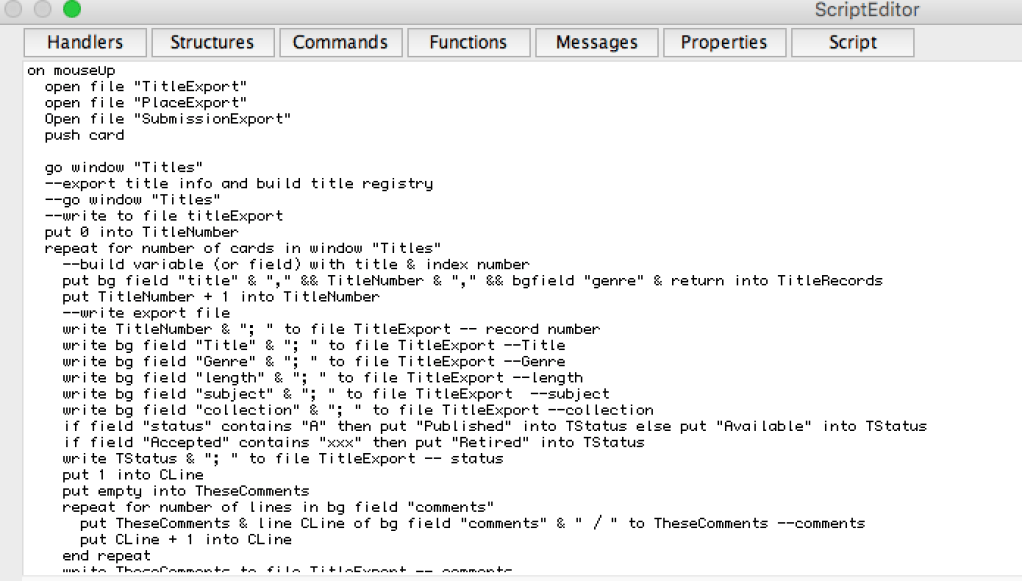
So I’ve been working on a program to export all my data to a semi-colon delineated file. (There are too many commas in my text for a true CSV file, but semi-colons also work.) This way, I can import into Calc, Libre Office’s version of Excel, and then into Base to set up a database to track my submissions. Here’s a little taste of that code:
It’s not that hard, really, but it does take awhile to decide what to put where so that it will correctly import into the database I’m creating. Last night, I accidentally clicked on the button to run the program when I meant to edit it. I let it crank along until the program crashed out in an error (in a part that I wasn’t finished with). Before it did, it exported the TitleExport file, and I’ve already found a couple of things I need to fix so that it works better.
I won’t bore you with those details, though…
The fun part, was to see that I have recorded submissions for 541 separate titles. A few of these are duplicates (such as a separate title for a book and a book query or excerpt), and many of them are translations. Not all have been published, though many have.
I’ll be curious to see how many different places all these titles have been sent. I’m sure that will be a much, much higher number, given that most titles have been sent to several magazines before getting published, and the book publishers I’ve submitted to probably number in the hundreds. Since I’m planning to keep a record of each title’s submission to each place it’s sent, the submission file will probably be in the thousands.
In the database, there’ll be one table of places to submit, since I’ll be combining journals, books, and contests into this one table, and one table that lists information on each title. A third table will cross-reference these and list only the title, the place, the submission and response dates, and the status of the submission. This ought to let me pull all the information I need about what titles are submitted where and which ones are in, out, or accepted, etc.
If that doesn’t work, I’ll have shell out the money for an upgrade and for the third party workaround I’ll need to keep SuperCard running — or I’ll have to limp along with my old Mac OS until I have to buy a new computer. Maybe by then SuperCard will have an upgrade, but in the meantime, it’s a fun challenge to see if I can make the export work and then get the database up and running the way I want. I’m in no rush, obviously, since I’ve been thinking about it and tinkering with it for the past year. But that’s only been in a few spare moments here and there, and this year those moments have been few and far between.
This year’s Tennessee Williams Tribute in Columbus, Mississippi, will be held virtually and streamed on Facebook. When I was asked to take part in the poetry panel, I gladly accepted. I’ve done it several times before, and it’s always fun. When it came time to record my segment, I pulled out my copy of his collected poems to search for one that I wanted to read. It didn’t take me too long to find it.
I chose “Orpheus Descending” because I thought it would be appropriate for this year of COVID-19. Orpheus goes to Hades to bring back his wife Eurydice. If you don’t know the story, he’s not successful because he looks back too soon to see if she’s coming. She hasn’t crossed over into this life yet, so she has to return to the land of the dead because he looked, though he had been warned. Williams doesn’t write his poem with this familiar ending, though. He writes the poem of Orpheus’s journey to the underworld, and many of the images he uses are reminiscent of other fertility myths from Mesopotamia that I have taught in World Lit, so this poem spoke to me.
All the poets were also asked to share one of their own poems, so I chose “Ishtar,” a poem about moving to Mississippi set in the realm of the Babylonian poem “The Descent of Ishtar.” They seemed like a good pair, and I was pleased with the reading. It will be broadcast on Facebook tomorrow, Sept. 12, which also happens to be my birthday. The poetry part of the Tribute is supposed to start around 11:30.
Interestingly, after reading the Williams poem, I began to think more about Orpheus, and ended up writing a couple of poems about his myth and about Eurydice. These went with a poem about Gilgamesh and another about Osiris. Though all are dealing with these myths of the underworld, they are also trying to get at the experience of 2020. If I hadn’t chosen this poem to read for the Tribute, though, I don’t know if my mind would have gone to these stories. It’s always interesting how what we read informs what we write, even though my poems are completely different than his. “Orpheus Descending” brought me back to my poem “Ishtar,” which led me on to my own take on the Orpheus story.
It’s after Labor Day, which means another year of MFA applications are starting. Over the past five years, I’ve been writing advice on how to write a statement of purpose, what to include in your writing sample, how to find the best programs for you, etc. The fact of the matter is, from year to year that advice doesn’t change all that much. As our low-residency MFA program has grown and I’ve seen more and more applications, I’ve adjusted or added to some of my original advice, yet those early posts still get the lion’s share of hits, which is fine, since they’re still valid.
Over the years (our program started in 2015), I have tried to give advice, not just on how to get into a program, but on whether to do that and how to afford it if you do. I’ve written on the choice between fully-funded residential programs (great if you can get in and if they’re right for you) and typically not well-funded low-res programs (where you are able to keep your better-paying job if you have one). I’ve also pointed readers to my program’s Guide for Applicants, which combines a lot of this advice in one pamphlet that I hope is helpful for any program, though tailored for ours.
If I had to give advice to someone considering applying for grad school this year, I would encourage them to consider established low-residency programs that know how to deliver distance learning. Compare low-res programs for the two main types: the individualized mentoring model or the online course model (hint: ours is the latter) for their relative strengths and weaknesses and for the kind of experience you are looking for. In the age of COVID, many MFA programs have moved online for the fall semester and probably for spring as well, so it makes sense to compare resident programs with good low-res programs who have established practices. Look at how low-res programs are handling their residency requirements (many of us are holding virtual residencies) and see what resident programs are doing to provide that kind of content that used to be face-to-face.
Who knows what Fall 2021 will bring. Maybe things will be closer to normal by then — we all hope they will be — but if not, a program like ours that is built to work in a distance environment may be your best bet. On the other hand, if you can get funding for a resident program, even if that program starts out online, it may still be your best choice. Consider how you’ll work as a teaching assistant or what other duties might be associated with your aid if undergraduate classes aren’t face-to-face. Fortunately, there will come a time when COVID-19 is not the first thing we think of when making any decision, even if that is hard to imagine right now. Unfortunately, I can’t predict when that will be.
When choosing programs to apply to, don’t just go for the most well-known ones with the most glamorous writers. Do your research. There are many smaller programs with excellent teachers who may not be household names (are any writers household names?) but who will be excellent mentors and even friends, and who attract serious, committed MFA-student writers who will become lifelong writing buddies. Really get to know the programs you want to apply to, and you will write a better letter. You will increase your odds of getting accepted because you will apply to schools that are a better fit for you and you will present yourself appropriately. That’s really all we’re looking for: serious writers who have taken their application process seriously and who will be a good fit for the culture we’ve tried to foster in our programs.
Looking for more advice? Here are my 10 most recent posts in the category MFA Application.
Now that it’s January, we’ve started to see some applications again for our low-residency MFA program for another year. This has me thinking about all the advice I’ve given to applicants over the years. If I could give one piece of advice on how to apply, I think it would be to just be you.Continue reading “MFA Application Advice 2024”
Over the years, I’ve written quite a bit about how to write your statement of purpose for a low-res MFA program. That advice is still valid, but I felt it was time to return to it again and to update it somewhat. I’m curious about the things most applicants leave out of their statement, andContinue reading “Returning to the Statement of Purpose”
Next week, I’ll be headed to Seattle for the annual AWP conference. If you don’t know that acronym, it’s the Association of Writers’ and Writing Programs, an annual gathering of thousands (often over 10,000) writers, teachers, publishers, etc. Virtually everyone is a writer, but we all wear a number of hats. I’ll spend most ofContinue reading “Meet me at #AWP23”
It’s that time of the year again — the time when writers everywhere get serious about looking for an MFA program. It only makes sense, with many application deadlines coming due in December or January, if you want to be in an MFA program a year from now, you’ll want to get serious about lookingContinue reading “Ranking MFA Programs in Creative Writing”
Labor Day should not be a day of labor, theoretically, though many use it as a day to take on a home project. In my case, I spent a good part of the day working on submissions. I won’t reveal exactly where I submitted, but I will say that I looked at a recent Duotrope newsletter to see what markets had recently opened — and there are a lot. Sept. 1 is a common start date for reading periods, and it’s good to get your submission in early, so Labor Day is a prime day for getting those submissions out the door or at least getting organized to do it this week.
I also had group of 7 new poems that I’ve been getting ready to send out, so this year was particularly fruitful. Those new poems, combined with a few others that aren’t out anywhere, gave me 3 submission packets that I could simultaneously submit to some of my favorite magazines.
I like using Duotrope as a reminder of places that are reading right now and that I might otherwise overlook until well into their reading period. Several of the places I submitted do not use Submittable, which is another advantage. As much as I like Submittable, I also realize that everyone else loves it, too, and sending to some journals who are not in that ecosphere can help my prospects. A few of my submissions yesterday went through Submittable, though. It’s not like I avoid them; I just try broaden my horizons, even preparing one submission to go out by mail. Here’s hoping it gets there before election day!
(PSA: If you haven’t registered to vote, there’s still time.)
I even sent out one book manuscript to a great open poetry collection contest, and I have my eye on a few others. I’ve been working on revisions to my fourth book, incorporating the new poems and also rearranging some of the sections. And because I’m a professor, of course, I spent some time prepping for classes and even held my night class because the students voted to do that. But it was restful and energizing to devote several hours to writing and sending out poems.
Trethewey’s memoir recounts her life with her mother and her odyssey to understand her mother’s murder at the hands of her stepfather. It is an exploration of memory and of the narratives we tell about our lives to make some sense of them even in the face of enormous tragedy. We are confronted with her mother’s death from the first page, yet we also see Trethewey’s own experience growing up in Mississippi in the sixties with both the safe haven of family and the constant threat of racist violence, and then her experience of her mother’s divorce and remarriage in Atlanta, and her mother’s attempts to free herself from the abusive relationship. Trethewey struggles with her own survivor’s guilt and with her attempts to retrieve the past that in the immediate aftermath of the murder, she had done her best to jettison and forget. It is a haunting story, masterfully told: at the same time highly personal and universal. It is a story that will remain with you long after you’ve turned the final page.
A little rant about emails with false or misleading subjects.
I just got one with the subject line “Ruth Bader Ginsburg.” The message went on to say that Justice Ginsburg would not be confirmed by the Senate today. On the one hand, that’s undoubtedly true. Mitch McConnell, the true subject of the email, probably wouldn’t allow any nomination like hers through, but he won’t get a nomination like hers and we can hope there won’t be a need for any Supreme Court nomination before the election. On the other hand, it’s a pointless argument and a waste of my time, even though I’m generally sympathetic to the argument that Mitch McConnell needs to be defeated. This email won’t cause me to donate money, though.
Instead, what seem like hundreds of these emails get sent to my trash every day. I don’t read them, and they make me generally disinclined to donate. Even the good ones that nonetheless have dramatic subjects like “If we don’t meet our fundraising goal tonight, ALL IS LOST!” get trashed. I highly doubt that tomorrow those same groups won’t be back with similarly urgent messages. So I trash them after a brief scan of subjects and senders to see whether there might be something I actually care about (a rejection or acceptance from a publisher, for instance) luking in the weeds.
I trash them without reading and without caring. The less I read, the less angry I become at groups that I actually do care about. I’m angry at the marketers who use aggressive and proven tactics that flood my inbox with junk. I try not to be angry with the politicians who have stooped to these tactics — they could be courting billionaires, after all.
But I’ve chosen to give to the candidates and the groups that I choose, and to do it on my own timeline, not on their arbitrary deadlines. I won’t respond to or even open those emails (they can tell when it’s been opened) as way to discourage these marketing practices, which is no different than screening every call with Caller ID. I won’t give to every candidate; I tend to focus on national campaigns and on my own state races, plus some for the party funds for House and Senate.
Has this reduced the number of emails I receive? I doubt it, but at least they don’t make me as angry and I feel no guilt hitting delete.
Remember all those pictures of kids on their first day of school? The pictures may be a little different this year. Yesterday was the first class day at Mississippi University for Women, where I have taught for 26 years, and though campus was abuzz with activity (at least compared to being a ghost-town during quarantine and over the summer, when I was often the only person in our building).
Still, with only one or two classes at a time in our building and class sizes for most face-to-face classes at 10 or fewer, it was nearly impossible to take a photo of students in the hallway. They can wander in a few at a time and follow the arrows on the floor to their classrooms. We have 1 class per day in each room of our building, and most of our classes are online, especially the larger ones, so we feel pretty comfortable.
Chairs and desks have been moved to create work spaces for students that will keep them at least 6 feet apart, and if the instructor is wearing a face shield rather than a mask, then the front seats are left empty so we have at least 10 feet (probably more like 12) between the instructor and the first students. All classrooms have webcams and microphones for Zoom broadcast of a class to a student who can’t be present or recording if they can’t be there at the same time.
With these measures, the number of students in our building and the number of students who are living on campus has been dramatically reduced. We hope that we can go for some weeks and maybe until Thanksgiving before we have to send students home. But we don’t know what students will do in their free time or who they may come in contact with when they’re not on campus. Ours is a commuter campus and not primarily residential in a typical year. Students often go home on weekends, so there are many uncertainties.
Nonetheless, we’re doing what we can to reopen safely. If anyone is interested, you can view our campus renewal plan. It’s far from perfect, but for a small, regional public university, we are doing our best. One thing that has helped us is that we have been involved with online learning since the beginning. I’ve been teaching online for nearly two decades, longer if you count the supplemental online discussion boards I set up before we ever got our first LMS (does anyone remember WebCT?).
This year, we’re experiementing with more synchronous online classes, which I’ve been doing in our MFA program for years. But now we can finally list a class as synchronous on the course schedule and list the timesthat a student is expected to be in class. It will take some re-education of students to train them what to look for: some thought they had to come to a classroom since a time was listed (but no room), and some probably think they can do any online class asynchronously.
We know there will be challenges, but if some of the measures we have implemented work and if we learn from the ones that don’t work. We should be able to move to a slightly more normal semester by Spring 2021. And if it all goes to heck again as it did last semester, we will be better prepared to pivot to all online learning.
 The Big Door Prize by M.O. Walsh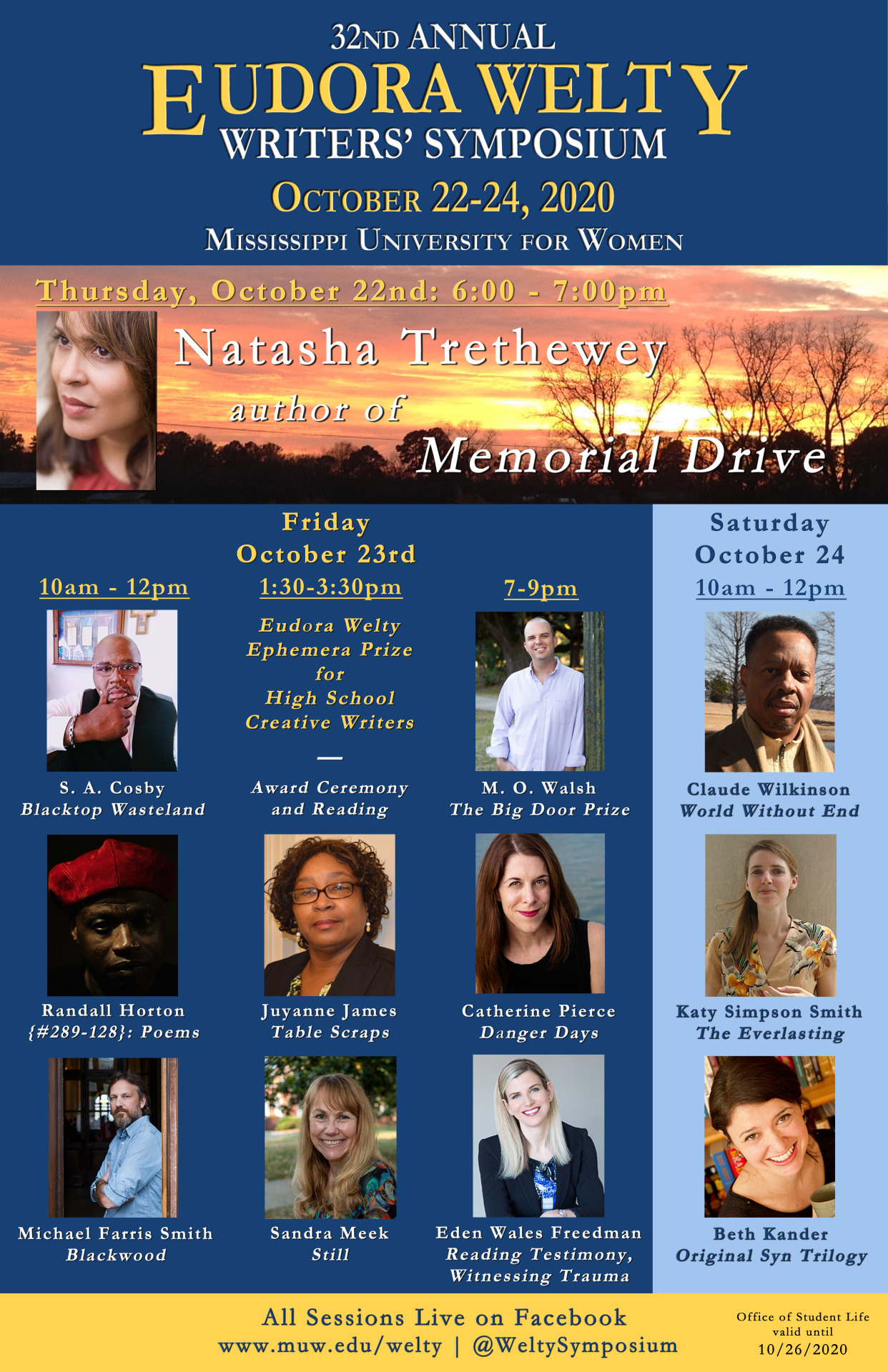


 Kendall Dunkelberg