In Memoriam: Jim Brock

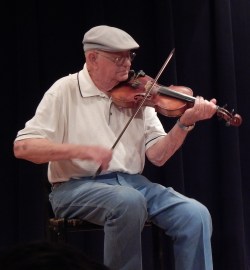
DSCN6917A legendary fiddler passed away last week. Mr. Jim Brock of the small town of Aliceville, Alabama, was a much more influential figure than many who knew him casually probably realize. In recent years he had recorded a couple of CDs locally (Me and My Fiddle and The First 55 Years), but hadn’t been active on the music scene.

Starting in 1952, though, he played with Carl Sauceman and the Green Valley Boys who had syndicated shows on radio and television. He would go on to play with Jim and Jesse and the Virgina Boys and with Bill Monroe and others, as well as to have a regular stint at the Grand Ol’ Opry.

The way I met Mr. Brock, as we always called him, was when our son, Aidan, started taking fiddle lessons with him. This was one of the greatest opportunities we had through our local Arts Council. We saw in the paper that Mr. Brock would be giving lessons, and Aidan had been playing violin with the local Suzuki group for awhile. We’d heard Mr. Brock play with a young local fiddler named Ruby Jane Smith, who he’d also taught, so we knew it was an incredible opportunity.

When we first started lessons, it was quite an adjustment, though. Mr. Brock told us right away that he didn’t read music, so Aidan would be learning everything by ear. That took a little getting used to, but Mr. Brock suggested we bring a video recorder to tape the songs, so Aidan could use that to practice with. After about 8 years of lessons, we have many, many hours and about 250 songs on tape, some well known standards and some West Alabama tunes few others know. By that point, Aidan and Jim were stretching Mr. Brock’s repertoire and getting beyond the point where taping was even necessary. Mr. Brock had introduced us to other fiddler greats, and Aidan often picked tunes up from their CDs.

Along the way, we moved from taking lessons in town at the Arts Council to taking them from Mr. Brock at his house in Aliceville. We often made the drive on Sunday afternoons down Hwy 69 from Columbus, through Pickinsville, and on to Mr. Brock’s house. So the drive this past Sunday down to the funeral chapel for visitation was a sad but familiar one. It was good to see his son Jimmy, who played with his dad in The Echoes, and his daughter and son-in-law and to pay our respects.

Jim Brock was a very humble and giving man, for whom passing on this music was clearly the most important aspect of the lessons he gave to our son and several other students. During the lessons Mr. Brock would often tell stories of the fiddlers he’d played with over the years, the jokes they’d tell, the wild life some of them (but not Jim) got into on the road. I often wished I’d had that recorder going when he launched into a story.

In addition to the lessons, Mr. Brock aslo encouraged Aidan to perform, asking him to join in on a few tunes when he played a concert at the Arts Council and agreeing to play with Aidan for the Columbus Pilgrimage or other events. And he invited Aidan to come out and sit in with him and Gene Robertson’s band, The Echoes, at a local dance. It was there I finally learned the two-step (at least a little) and got to know a great group of locals who liked to come out to the senior center to dance and have a potluck twice a month. Eventually, Aidan would put on his own concerts and invite Jim Brock to join him on a few songs.

Jim Brock became more of a friend and mentor than a music teacher. The world has lost a great soul with his passing, and though we know he is better off, we still mourn his loss.  We are honored to have known and learned from this master fiddler and generous man.


Book Review: Gumbo Life by Ken Wells

Gumbo Life: Tales from the Roux BayouGumbo Life: Tales from the Roux Bayou by Ken Wells

My rating: 4 of 5 stars

I need to preface my review by saying that I’m a vegetarian. This book is more aimed at carnivores, and I’m sure Wells would find my vegetarian gumbo sacrilegious, though he proves to be an adventurous eater. And no, I wouldn’t put quinoa in soup and call it gumbo as Disney apparently did (though quinoa soup is delicious in its own right). So maybe Wells will forgive me.

Anyone who is a fan of Louisiana culture or of great food writing will find a lot to love in this book, whether or not you eat chicken, seafood, or sausage, however. It’s probably impossible to impart the secrets of a good roux if you’re not standing over the pot as Wells describes his mother teaching him (after a failed attempt at providing instructions over the phone). But Wells comes as close as anyone can in numerous descriptions of the gumbo cooking process, as his mother and others he knew growing up did it, as the chefs in a gumbo contest do it, as a number of restaurants do it, and even as a it is done in mammoth kettles for mass production. He even confronts the question of whether gumbo originally was made with a roux or whether that was a later addition, and whether its origins are primarily Cajun, Creole, African, or Native American.

Writing in a lively and entertaining style, Wells always blends the personal story with the history, the science, and the culture of gumbo. Wells chronicles his own fascination with this Cajun/Creole staple, and he documents its history and lore as he explores the culinary diaspora that has made it available around the world, showing his journalism credentials in the depth of research he has done and the number of chefs and others he has interviewed and the number and types of gumbo he has sampled. The recipes collected at the back do not only give a sense of the range of gumbo styles Wells has covered in the preceding pages, they also provide inspiration for continued experimentation with this quintessentially American dish.

View all my reviews

Book Review: When you Learn the Alphabet by Kendra Allen

When You Learn the AlphabetWhen You Learn the Alphabet by Kendra Allen
My rating: 5 of 5 stars

Kendra Allen’s essay collection When You Learn the Alphabet is an important collection of essays on race in America. Allen writes in several forms, ranging from memoir, to lyric essay, to poetry. What I admire most about these essays is Allen’s willingness to examine her own humanity rather than analyzing society from an objective distance. In the essay “Polar Bear Express,”the narrator reveals that she lies to an old man on the bus to avoid a conversation and later regrets the missed opportunity. I’ve ridden Chicago busses and ignored this kind of conversation, so I can relate and find the honesty refreshing. Allen is often angry at the systematic injustices and microagressions (or just plain aggression) she witnesses in society, yet she also examines the roots of her anger, both in facing ever-present racism and in growing up in a family plagued by addiction (Aunt A), divorce, violence, and PTSD. There are no easy answers, and though I sometimes might disagree, Allen’s essays are always challenging and engaging. For instance, after reading her essay about a creative writing workshop, I would love to rshow Allen Anna Leahy’s Power and Identity in the Creative Writing Classroom: The Authority Project and question the instructor’s practice of reading student work aloud to the class. But I am also moved by Allen’s account of her reaction to hearing her white male instructor read the n-word aloud, rather than having her black male classmate read his own piece. Whether I ultimately agree about the politics of who can read this word, I gain by learning how Allen and her classmate experience this situation. The fact Allen exposes her own vulnerabilities allows this kind dialogue between narrator and reader and shows a level of maturity that is rare in a first collection.

View all my reviews

Book Review: Biloxi by Mary Miller

BiloxiBiloxi by Mary Miller

My rating: 5 of 5 stars

Disclaimer: Mary Miller is my colleague in The W’s MFA program in Creative Writing. I’m a big fan of her work.

Biloxi is a hilarious read, though it’s not laugh-out-lout funny, outlandish, or bawdy. Mary Miller’s humor, to my mind, consists more of taking wry, sardonic pot shots at contemporary culture in a loving, even complicit way. Her novel is not driven by plot; instead it presents a complex character study. Louis McDonald, Jr., her rather clueless yet lovable main character, navigates a personal crisis after his divorce, and the point is not how well he succeeds or even how he learns or grows (though arguably, he does). The point is that we understand him and explore his world, a world Miller knows intimately, from its burger joints to its sad strip malls, beaches, and casinos. Or maybe the true main character is Layla, the dog, and we are like her, lapping up every tasty morsel, every slice of bologna Mary Miller tosses on the kitchen floor for us, occasionally nipping at a brother-in-law or running off only to return to our new home after awhile to see what other leftovers may be lying around. This novel is introspective and insightful, though it doesn’t offer easy answers as much as it offers a mirror onto the 21st-century, mid-American consumer culture we all inhabit, like it or not.

View all my reviews


Word Processors for Poets

Today’s my birthday, so my gift to you is a recommendation of free software.

Poets get a bum rap for never having money (it’s true!), but that’s not why I’m recommending two free word processors today. And it’s not because poets are so anti-establishment we have to fight against Microsoft’s domination with alternatives to MS Word, though that may be a noble cause.

Even Apple with Pages (free with your Mac, so not exactly free) might be worth fighting against on those terms, but I don’t mind it as much as Word. Pages doesn’t do the things that bother me most about MS Word, so it might be a good alternative if you already own a Mac, but for the rest of the world (PC or even Linux users), there are a couple of great free options to Word. (Sorry Google, I’m not thinking about Docs!)

First, what’s so annoying about Word, especially for poets? I’ve always struggled with its default settings, which are geared to an office environment. For one, I always have to instruct my poetry students how to force Word to single-space their poems. They set it to single space, but Word thinks every new line is a new paragraph and every new paragraph needs to have extra space between it and the previous one. Can we spell business letter, anyone?

(There’s an easy trick to fix that, actually: edit your default document template to set your default font and paragraph spacing options. It will affect every new file, but most of us don’t mind. Or create a poem template that has your settings for poetry, so you can keep your business letter template as default, if you must.)

The other annoying habit of Word isn’t quite so easy to fix. Word likes to have a capital letter at the beginning of every new line. It apparently thinks it’s a new sentence as well as a new paragraph, so in order to turn this feature off, you have to turn off capitalization at the beginning of a sentence. But then all sentences are affected, not just the ones at the beginnings of lines that aren’t really the beginning of sentences.

So the quicker, easier, and perhaps more gratifying solution is to switch to OpenOffice or LibreOffice. Both are free, open source office suites that are perfectly stable and secure. They do everything Word does, but the don’t treat poets like business execs (or their assistants). You don’t have to do anything to get them to work the way you want. They work well for poets right out of the box!

Both also include a database program, which might be more useful for keeping track of submissions than Excel. I’m currently working on that, and if I get it to work, I’ll post about it later. They both also have spreadsheet applications and other common office suite apps.

From what I’ve read, OpenOffice and LibreOffice are virtually identical, though if you want to save your files in Word format, then LibreOffice is the way to go. Both will open files in and save to a number of different formats that Word can see, and OpenOffice can save to a .doc file, just not .docx (which many people hate), so if you want to look like you’re using the latest Word when you exchange files, then LibreOffice is probably the way to go. Otherwise, choose the one whose icon or interface you like best or flip a coin. You can’t go wrong with either word processor, and you will be thankful for the reduced number of headaches they cause you, esp. if you write poetry!

Or you can do like a lot of Instagram poets I’ve seen recently: buy an old typewriter, type your poems, take a picture (typos and all), and post it online!

Book Review: Heavy by Kiese Laymon

Heavy: An American MemoirHeavy: An American Memoir by Kiese Laymon

My rating: 5 of 5 stars

Kiese Laymon’s memoir is an important book for our time and a great read! It is immediately more personal than many since he addresses each chapter to his mother. Understanding that relationship is the lens through which Laymon examines race, gender, sexuality, and abuse in his own life and through his experiences in Mississippi and across the nation. It is a story of growth and maturity, in which Laymon does not shy away from his own complicity in oppressive social structures. As a young man, he commits petty crimes and witnesses gang rape. He also recounts his own experience of sexual abuse as well as ‘discipline’ that might now be considered child abuse, but was accepted at the time. Yet Laymon’s goal seems to be to understand the deep sources of this abuse and how these experiences have shaped him and those around him. He also does not shy away from the troubles in his own relationships or his issues with gambling. For all the difficult subject matter Laymon takes on, this remains a memoir steeped in the optimism of “black abundance,” and it speaks to all Americans, regardless of gender or race. You owe it to yourself to read this book.

View all my reviews


How to Prepare to Apply for an MFA Program, Part 2

So you’ve been writing, revising, reading magazines and books (as I suggested in Part 1 of this series), and you feel like you’re ready to start the application process. How can you navigate the difficult journey to an MFA? Fortunately, there are a lot of resources that can help you choose a program and figure out how to write the best application possible.

First, how do you know when you’re really ready to apply? Sometimes you just have to take that plunge, but it can help to do some relection before you start the process. My low-residency MFA progam has a Guide for Applicants that can help you make that decision and help you navigate the process, and we hope it’s helpful for any program, not just ours. I’ve also written extensively on this blog about the application process. See the category MFA Application for posts like 15 Things to Do Before a Low-Res MFA that can help you prepare.

AWP, the Association of Writers and Writing Programs also has a series of articles about the MFA application process that can be very helpful in thinking about the process and deciding whether you’re ready to take the plunge. Poets & Writers also publishes an annual MFA issue in Sept./Oct. that can be very informative with articles about the MFA experience and advice on choosing a program.

Another free resource that I highly recommend is Kenzie Allen’s 10-day course at Literistic, “MFA Applications 101.” [Update, apparently you have to pay to access Literistic now, even content like this that used to be free. April 2023] This series of ten emails will walk you through the application process and provide many links to more resources than I can cover here. If you’re starting the application process or even just thinking about it, you owe it to yourself to sign up. The more you know about the process, the better you’ll be able to do to write your letter and hone your writing sample.

Other great resources include the MFA Years blog and the MFA Draft Facebook group: a new group is started each year, so search for the group if my link doesn’t take you to the right one. You must request membership and show that you’re an applicant, not a program director like me.

Finding a program is a little more complicated. Of course, you want to apply to the best programs you can where you’ll be competitive, but you also want to bear in mind the cost, location, and the culture of the schools you’re looking at. The best places to start your search are the guides at AWP, Poets & Writers, New Pages, and Publisher’s Weekly. You can find out everything you need to know to get started from these sites, and they all list slightly different information, so checking more than one is worth the time. They also link to program websites, which makes it easier to dig down to find out more about the programs you’re most interested in.

The common advice you hear about writing programs is to choose based on the writers who teach in the program. There’s a certain amount of wisdom in that — it they write like you write, then you might have a better experience working with them. That’s if those writers are truly active in their programs and if they are good teachers as well as good writers. But many of the best teaching writers out there are not the most famous writers you’ve heard of. Yes, the reputation of your thesis director could make a difference, but the vast majority of writers will make their way based on their own merits, not on who they worked with in grad school.

Better advice that you hear is to contact students in the program to find out what it’s like. Ask about hidden fees and about the culture of the program. What’s it like to live in the town for a full residency program or how a low-residency program works: do you work with a mentor or take online classes? How do you exchange files? etc.

Another piece of advice for choosing programs that I don’t hear a lot about, but have been thinking about recently, is to read the program’s literary magazine. From the magazine, you’ll learn a lot about the esthetic of the graduate student editors. Sure, the contributors for the magazine won’t be from the program (or if they are, that would be a huge red flag), but students in the program have chosen every piece published, so you learn what kind of writing interests them.

There is no magic bullet for choosing the right program. That’s why you’ll want to apply to more than one program, and you shouldn’t stop researching once you’ve sent in your application. Keep exploring the choices you’ve made, try to make connections or visit campus, write the programs to ask questions or get in touch with current students, so that when you are faced with a decision, you’ll have a better sense of what you want to do.

How to Prepare to Apply to an MFA Program, Part 1

Okay, so you want to apply for an MFA in Creative Writing, but you don’t know whether you’re good enough or where to start. You want to brush up on your writing and you want to put together the best application you possibly can. But how? In this post, I’ll try to give you some advice and point you to some resources to help you develop your writing. Then we’ll look at resources to help with the application process.

First, write. If you are going to be in an MFA program, you will write like you’ve never written before, so why wait until after you’ve been accepted? Start by writing every day or every time you possibly can. Write new material, try new genres, test your boundaries.

Next, rewrite. Don’t be satisfied with that most recent good draft. If your best writing was done in college, you would probably write it better now. Nearly any piece of writing can be improved or polished. Go back and re-read your older work, esp. if you don’t have ideas for new work. Try to find new layers. Do more than just correct errors (though fix anything and everything you can so you have absolutely clean copy). Sometimes this revision leads you to your next good idea. Going to a workshop or being involved in a writer’s group can be helpful, so you get feedback from others. If you don’t have someone nearby who can help, try going to a workshop or conference.

Finally, read. As I’ve said before, every MFA applicant should read widely in literary magazines. You need to know what’s being written today by the writers you admire (or the ones you’ll only admire once you’ve read them). You need to see what other MFA applicants are reading and what their professors are reading and writing. If you know what programs you want to apply to, read their literary journals to see the editorial choices of their current and former students. Our low-residency MFA program publishes two journals Ponder Review and Poetry South.

Go to bookstores and libraries to find the books that are being written that you’d like to emulate. What genre or sub-genre do you think you want to write? What authors are being published in those areas? Buy some books and read them! Or check them out from the library. Find out who those authors’ agents are. Start learning about the publishing industry.

You will have a better writing sample and letter if you’ve prepared yourself for your MFA than if you rely solely on your own talent.

That’s enough for today! I’ll continue soon with some resources that can help you with the application process.

Meet Me at the Book Festival

IMG_0089One of the great developments for writers in recent years has been the inception of state-wide or regional book festivals across the country. Mississippi holds its @MSBookFest in August on the Capitol lawn, and I’ll be there next weekend, August 17, for the fifth year. My first time, I went as a volunteer. My second year, I went as a writer with Barrier Island Suite, and for the past three years, I’ve gone to represent The W with our magazines, writing programs, and the Eudora Welty Writers’ Symposium at an organization table. I don’t get to hear as many of the great readers that way, but I do get to meet a lot of people and talk about writing and publishing in our state.

The readings take place inside the capitol building in the air conditioning. Our tables are outside in the shade, so the heat is never too unbearable, though last year we got some rain! Here’s some of what I’ll be missing out on inside. Mary Miller will read from her novel Biloxi, Kiese Laymon will read from Heavy. They will both also be at the Eudora Welty Writers’ Symposium this fall, so I will get a chance to hear them in October. There are many other panels with luminaries liek Joyce Carol Oats and Ann Patchett, as well as writers you may not have heard of, but whose work will delight.

John Bateman and T. K. Lee will be outdoors with me on Author’s Alley, where small press writers can represent their own books, and there are bookstores, food tents, and live music. It’s a great way to end the summer and start off the school year (if, like me, you’ll be heading back to classes soon). And it’s free! The only things you’ll need money for are books and food. Come enjoy a lovely Saturday (here’s hoping for good weather again!) in Jackson, Mississippi. And if that’s too far for you to travel, find the book festival in your state! More and more, it seems like something states are doing, and that’s great news for books, reading, and culture!

Learning from My Students

When I first started The W’s MFA in Creative Writing, I wrote in our Student Handbook (which I’ve been editing this summer) that the students are our colleagues, perhaps the teachers are a little further along in their writing careers (though not always older), but the students shouldn’t feel like they are any less because their experience is different. I meant it then, and I mean it today.

Of course, teachers always learn from students, no matter what level you teach, be it kindergarten or graduate school! In class, that’s the sign of a good class, in my book.

But what I’m thinking about today is about how much we learn and how much we appreciate it, when our students go on to do great (or small) things after they graduate. Today is commencement day, and five more MFAs will cross the stage: actually, only two can be there for the ceremony, but the other three will be with us in spirit!

Today, one of our recent graduates (the poet C. T. Salazar from December) announced that he did an interview with Benjamin Niespodziany at NeonPajamas. Reading it brings back memories of many things we dicussed together in the program but also of the great energy for reading and writing poetry that he brought to every class. I can see the influence of other poets in our program as well, and the ways he’s taken those influences, shaped them, and made them his own.

Reading essays by Exodus Brownlow or Katrina Byrd have the same effect. And I could link to something from each of our 15 graduates and most of our current students that would be just as moving. For a more complete list, see our program’s Accomplishments page, a page I desperately need to update, but I just can’t keep up with all the great work everyone is doing! (I’ll be asking for updates again soon!)

Learning in an MFA program doesn’t just happen in the classroom. It happens thanks to the connections we make, the conversations we have, and the brilliant work that we share with one another and with the world.

Today on commencement day for August 2019, I’m proud of the five theses and the work Thomas B. Richardson, Robin Taylor Murphy, Ashley Hewitt, Sally Lyon, and Courtney Clark have done in our program. But I am even more excited to see the work they will do and are doing out in the world. Commencement is a beginning, and we can’t wait to see what it will bring!