Groups in the Social-Distanced Classroom

Last week, I posted some late night musings on how a face-to-face classroom might be different under social distancing. I was surprised at the number of people who viewed that post — nearly 100 in the first day. And because I can’t ask questions like that without searching for answers, I’ve begun collecting some tools and brainstorming some ideas for how we could do group work in a social-distanced classroom.

I will continue collecting these tools on my discussion group for my textbook,  A Writer’s Craftsince I am thinking primarily about how creative writing can be taught using something like the group work I’m used to doing. Even trying to wrap my brain around this, though, has me thinking about how much more efficient it is to have students sit next to one another and talk. I can give them index cards with instructions, and I can pass those out rendomly to different groups to get them through a prompt. Or I can have them all write the same prompt individually and then turn to a partner or a group and share what they wrote. It all seems effortless compared to exchanging even short files with partners in a digital forum. But you have to sit exchange paper or sit near someone and talk: in either case, you’re also exchanging germs.

Lecturing can be deadly in a creative writing class, though, since it thrives on active learning. Students learn to write by doing, not just by being told what to do. While I’d love to find a way to electronically pass index cards around groups of 2-4 students (not share with everyone at once, but pass messages around a group), and I’d love to find a way for students to talk in a group without actually talking (since we’ll be in the same room but too far away from each other to talk quietly), I might be willing to settle for some other activities for students to do to break up a lecture and get them writing and thinking together. That’s why I’m looking for active ‘toys’ that can be adapted to creative writing tasks. Here’s what I’ve found so far. If you have suggestions, please let me know!

Hypothesis looks like a great way to read and comment on texts together. The text needs to be either a PDF or a web page. It might be good for making comments on a draft the student saved as PDF (as long as that isn’t public) or on a poem or story in an online journal. The group can write annotations of text to critique it or they could write creative annotations to respond to or make found poetry or found art out of something online.

Educaplay offers a number of games for use in the classroom. Some that seem promising are the Dialogue Game, Fill in the Blanks, Riddle, Unscramble Letters, and Unscramble Words. My main question (not having tested these yet) is whether students can create their games or whether the instructor has to create the game for students. Either could be useful, such as a fill-in-the-blanks game to create a poem with the blanks ro a dialogue game to create dialogue for a scene.

Draft is an online word processor that allows collaboration on drafts with the people you invite. This could be useful for sharing group work, especially if you don’t want to use Google Docs or Office 365.

Google Docs also allows users to share documents and collaborate on drafts. This could be used to share documents in groups and to allow readers to comment or add content to a draft. One advantage for Canvas users is that Google Docs is the default method for Canvas’s Collaborate feature

Speaking of Canvas, the Pages feature can also be used for collaborative writing. A page can be set to be editable by students. You could use the Groups feature to put students in groups and then give each group a page to compose in with the exercise instructions. They could write together on this page.

Trello is actually a project organizer for group planning, but it seems like it might be adaptable to smaller projects like group work. You can set up cards that can be annotated or commented on, and you can even create automated workflows. The free account allows unlimited users and up to 10 boards, so I could see using it for group work 10 times in one semester before I had to delete my boards. Or possibly, if I could have one board per class, and then create each group activity as part of the board, I could keep our work available all semester long. Assigning people to work on those activities might be a challenge, especially if I wanted to be in different groups each time, which I do like to do.

Quizlet seems primarily geared toward study aids and tests, but I wonder whether some of their ‘sets’ (like flashcards) could be adapted to group work. I haven’t explored Quizlet too far yet because I keep getting put off by the emphasis on learning rather than creating, but like Trello, I think somehow it might be adapted to more creative group activities.

I’m primarily looking for free tools that can be used without requiring a lot of cumbersome logins. Ideally, I could find one or two, maybe three tools to use for a few types of group assignments, so students don’t get bored doing the same thing all the time. I don’t want them (or me) to have to keep up with too many subscriptions or login information, and I do need whatever tools I use to be accessible on a phone, so that they don’t have to bring a laptop to class (though typing might be easier on a laptop). And I want to be able to adapt the same tools to an online class if we have to go back to all online instruction at some point.

I’ll keep adding to this list of tools in the discussion group on Goodreads for my textbook.

Online or Social Distanced for Fall Classes?

As our university is working on a plan to reopen in the fall, I get why we would want to do it, but I’m also wondering what it will be like to teach in a social distanced classroom. Everyone would love to be back to normal, but that’s highly unlikely to happen.

Online classes have a lot of advantages, actually. Though students won’t be able to interact in the same ways they would face to face, they can interact in proven ways online. There are asynchronous methods such as discussion boards and text-based content or recorded video lectures, and there are synchronous methods like the ubiquitous Zoom classroom.

Though moving back to the classroom seems ideal, it may actually be less interactive than online. For instance, a lot of us use techniques like group work that will not be available in a classroom where students should wear masks and sit at least six feet apart. How do we get students to interact with one another in this setting? I could lecture, but that’s not the way I want to run a classroom, especially not for creative writing. In group work, we pass texts back and forth and write on each other’s papers — that won’t be possible with social distancing.

If I’m in the classroom with students, I suspect I’ll need to adapt some online course delivery methods there as well. I could see letting students exchange writing by chat or in a discussion room. I’d love to find a tool that would make this more interactive and fun. But of course, doing that will also require that students bring their devices to the classroom so they can communicate with one another despite the distance.

Hybrid classes may be the norm, rather than the exception. Some things will make sense to do in the classroom, and some things will need to be taken online, even if students are sitting in the same room with each other. Class sizes will also need to be small, so for some classes it may be that only half the class can fit in the social distanced classroom at any one time. We may need to alternate days and find ways to include those who are off-site in our discussions. Rethinking the classroom experience may be more complicated than it was to take all of our face-to-face classes online suddenly this spring.

It would probalby be easier to be all online, but we’d miss the connection we have with students when we meet physically in one place. Whatever happens, we’ll have to do everythign we can to maintain that connection, and whatever happens, we’ll need to use every tool in our took kit (and then some) to keep communication open whether that is in the classroom or online. It will take a lot of creativity to make next semester work, but the best part of that is that the lessons we learn from teaching under COVID-19 are ones that we can still use when life truly goes back to normal.

Why Brag About Publishing a Poem?

Bragging is not something that comes naturally to some of us — then there are those who do it all the time and drive the rest of us up a tree.  So it doesn’t go without saying that you should brag about every poem that you publish. For some, it may seem ostentatious. After all, a poem is a page, maybe two or three, so getting a page published might not seem like such a big deal to fiction writers who publish maybe 15-30 pages at a shot. But a published poem is a publication, and there are several reasons I’ll post about it on social media (which feels like bragging).

  1. First and foremost, every post about a magazine is like a little ad for that magazine. I want people to know where I’m publishing. I want to them to go out and read and support the magazine. Maybe someone will buy a copy or maybe someone will visit the site and ignore the ads (if there are ads). I want people to read my work, but I also want people to see the other writers in that magazine and read them, too.
  2. I’m a professor, so I want my students to see that I’m publishing and where I’m publishing it. We should always try to be good examples for our students, and we should let them know that publishing doesn’t magically happen. We also have to work at it, so every publication counts.
  3. I work hard at writing and publishing, so I deserve to let people know. “Black Racer,” the poem that was published this week in Valley Voices had been turned down by four other journals. That’s a pretty good response rate. Often a poem has been to more before ever getting accepted. “A Necessary Lie” was accepted on its 8th trip out the door in two and a half years (I don’t do many simultaneous submissions, so it can take awhile). “The intergalactic traveler makes a Kroger run” got accepted by the first journal. That’s rare.
  4. Both of these were picked up by Juke Joint, a great online magazine I’ve been sending to for a couple of years, and each time I’ve gotten rejection letters with encouraging comments — until now, when half my submission (2 poems) was accepted. Again, that’s a pretty good track record, so why not celebrate?
  5. Celebrating the successes, even when that is a poem here and there, keeps you honest. It’s a reminder that as great as it feels to have your work in print, there is still more work to be done: more poems to write, more poems to submit, more rejections to catalogue and more acceptances to hope for.
  6. For every success, countless poems are returned to us. Poets and writers know the odds at most journals are stacked against us. Posting about our successes serves as a reminder to ourselves and to other writers that those successes do happen.

Do I want you to think I’m the greatest thing since sliced bread when I post about a poem that has been published in a magazine? Of course not. I know there are many more imporant things in the world. But if it gives someone the incentive to read or if it gives someone else the incentive to keep sending out their work, then it’s worth it.

Why We Teach

In this era of COVID-19, it can be easy to lose track of the big picture and get caught up in all the details. I was reminded of this the other day, when a former student, who I hadn’t heard from in a decade, posted a comment and tagged me in Facebook. She mentioned something I had said (yes, it was a compliment, not a complaint). We commented a little back and forth, and another student chimed in, mentioning another class.

What this reminded me of is something I have always felt. We teach, not for the class or the test or the essays students write, but for the future. I care more about what a student will take from my class four, five, even ten years later, though more times than not, this is something I never know. It’s rare to see a comment like this or to run into a student and have them tell you in person. And that is how it should be (though it’s incredibly rewarding when you do hear from students).

Education is not about immediate or even tangible results. Of course, we give tests and papers, and we want to push students to excel and we want those tangible results. But the bigger point is what happens later. It’s great to see our students succeed after they graduate, and it’s great to find out that something we said or taught mattered. I try to remember that students who struggle in a class, who may earn a B or C or even lower, may still be the ones who get the most out of it. They may not be able to show ‘mastery of the material’ during that semester, but if something sticks with them, then the seed is planted and they will benefit in some way, someday, maybe in unexpected ways.

It’s hard to remember this when we’re all struggling to keep up and to stay connected with students who are suddenly being taught at a distance. Our struggle to keep teaching and our attempts to be fair and yet to be as rigorous as possilbe will be a big part of what makes an impact. The most important lessons taught in a class are often tangential to the material that is covered. The greatest lesson can often be given just by caring enough about every student, meeting them where they are, and helping them improve. In the end, it’s not about the grades and it’s not about the degree; it’s about that human interaction, communication, and faith in each other.

A Look Back at #AWP20 in San Antonio

Receently, the Association of Writers and Writing Programs sent out a survey. They didn’t ask specifically about the conference, but their last question asked about our experiences in the past month or so. That was probably wise, since not everyone on their list went to the conference or was even planning to go, but asking that question gave me the opportunity to put some thoughts together about the conference. Here’s what I said (edited and then expanded on for this blog post):

We came to #AWP20 in San Antonio, and I felt AWP did the best they could with the information they had at the time. In hindsight, events like ours should have been cancelled in February, but with two days’ notice and everyone scrambling to cancel hotel and airline reservations (when it wasn’t yet clear that could be done), and with product shipped to the book fair, it was right to keep the conference on for those who wanted or needed to come. We haven’t heard of anyone getting sick from attending, so we apparently dodged that bullet unlike some other conferences at about the same time. I don’t blame AWP. If the national response had been clearer, they would have known in plenty of time that they had to cancel, and they would have done it.

Of course, everyone knew that the virus was out there. What we didn’t know was that what we had been told was wrong. We were given the impression that the virus was contained in a very few places and most of the U.S. was still safe. That was clearly incorrect. What we learned two days before the conference was that someone from an air base near San Antonio had been released from quarantine, stayed at a San Antonio Hotel, and then tested positive for the virus and sent back to quarantine. What we should have known was that the virus was out in places like Boston and New York, not just isolated in Seattle and a few people in quarantine. We should have known that travelers from Europe and the Middle East, not just from China, could be carriers. We should have had testing that would have let us know the true risks of public gatherings. We were just starting to learn that on March 2 when the news broke about the sick woman who had been released into San Antonio for about 24 hours that weekend and when the mayor of San Antonio declared a medical disaster (to keep other quarantined patients from being released).

I am glad for the many people who stayed away from the AWP conference, and I’m glad that AWP allowed anyone to cancel their registration at the last minute, which made that possible. I am glad that half our group went to the conference — we had a great, if surreal, experience, and none of us caught the virus or spread it. But we could have.

With better information, we probably would have made different decisions, but actually with better information, we wouldn’t have had to make a decision. AWP wouldn’t have been one of the first groups to face a decision about their conference. They would have known the risks well in advance and been able to cancel responsibly with enough time to give everyone a chance to cancel reservations or not ship their merchandise to the conference book fair. There would have been a national order to limit social gatherings that would have forced large conferences to cancel or postpone. That still hasn’t happened, but states and most groups have stepped up and made the difficult decisions anyway.

#AWP20 was right on the cusp of that happening. While we were in San Antonio, we learned that South by Southwest had cancelled. Other major events and venues soon followed, including the NBA and NCAA basketball tournaments. If our conference had been a week later or if we had gotten good information in the weeks leading up to the conference, we would have been one of the ones to cancel instead of one of the last to go forward and make the best of things. I’m glad we did what we did, and I’m very glad the virus didn’t seem to be spread at our conference, as it was at CPAC, AIPAC, and BioGen, other prominent conferences held about the same time. But I wish that we and all the other conferences had been given the information we needed to make better decisions, and I really wish that the U.S. response to COVID-19 had been led by science and testing and not by misinformation and denial.

@ATThelp Conclusion

After playing phone tag with Delva, we finally connected. At first she didn’t seem to understand what the problem was, but after I explained the delays we had encountered with our upgrade to fiber, she said was able to offer a $50 credit. It took over a week after our installation to get through to someone who would actually do what had been promised, but it has now appeared on our account. And we did get our upgrade to fiber internet, which is working very well (and the installer was great). So that closes this chapter in our ATT story.

Phone tag with @ATTHelp

Before I continue my little rant at ATT, let me say that we did finally get our upgrade from DSL to fiber, and the technician who came out was very friendly and helpful. I have no complaints about him, though I did have a terrible experience the first time. And now I’m stuck in customer service limbo.

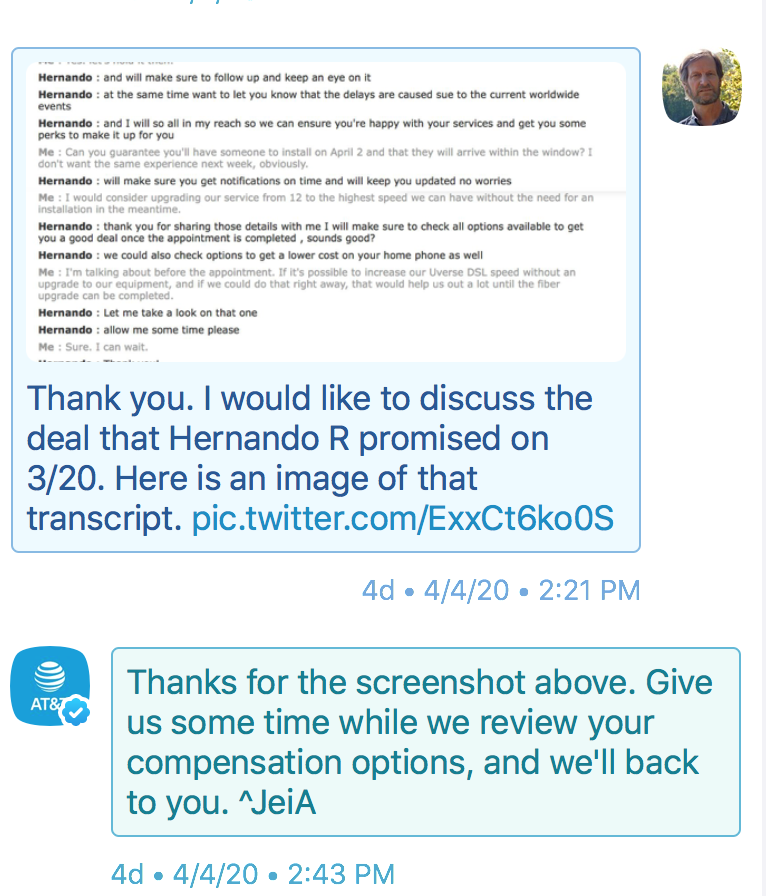
As you can see if you read the post linked above, we waited all day for the service tech to arrive the first time, only to have him cancel and claim that he had called us (which he hadn’t). So we got bumped to the end of the line and made to wait two weeks for the next appointment. Along the way, I’ve been in touch with ATT customer service through @ATTHelp on Twitter and through their website chat feature. At the time, when I told them about the terrible service I had received, I was promised that they would offer me a deal to compensate, once the upgrade was installed. Now, that appears to be another lie. Here’s the transcript, where Hernando promised a deal as compensation for the poor service I received.

ATTChatTranscript1

It’s now a week after our installation, and no word from Hernando. @ATTHelp did respond after a couple of days, and after I sent them the transcript above they said they would “review your compensation options.” As usual, though, then they disappeared with complete radio silence. Here’s the last I heard from them:

Screen Shot 2020-04-08 at 6.17.21 PM

Last night, I got a call to my cell phone, which I just tried to return. According to her message this is someone in ATT’s president’s office. Maybe we’re getting somewhere? Or will we keep playing phone tag? Delva is supposed to call me back within one business day. We’ll see what happens!

ATT Run-Around Follow-Up, Part 1

This morning, I was contacted by Hernando on ATT’s Social Media team @ATThelp. He said he wanted to help with the issues I experienced yesterday, so I connected to chat with him (it took a couple of tries before I got to the right person). I had already been looking into whether I could change our upgrade to one that didn’t involve a new installation, but ATT wasn’t showing me any options for service anymore.

Hernando did apologize for my experience yesterday, blaming it on the worldwide crisis. Though I agree, I also know that ATT can be hard enough to deal with in normal times, and I’ve had this kind of service before. He couldn’t change my install date, though he did say he would watch and let me know if an earlier date became available. And he made me a vague offer of a deal and perks, once the installation was complete. He gave no specifics of what those would be, though. Here’s a little bit from our transcript.

Hernando : I can confirm they are set for April 2nd if you agree I can hold the case so we can ensure the install
Hernando : and after thats completed we can check further options to compensate you due the long wait

I also asked him to check on whether we could get an upgrade to a higher speed without an equipment upgrade. I know those options were available to me when I initially ordered this upgrade over a week ago. According to the ATT website, I should be able to double, triple, or even quadruple my speed for the same price. Of course, that’s not better than about 80x our current speed that I’d get with fiber, which is also the same price for new customers as the lower speeds (though fiber isn’t available everywhere). I could live with a higher speed, even if it’s not fiber, if that meant they didn’t have to send someone to my house, my cost wouldn’t go up, and they could switch us over right away. But Hernando said I didn’t have those options anymore. Their website won’t show me what’s available in my area online. It tells me I have to call to place an order.

So we’re stuck in limbo, hoping that Hernando really will come through with promised deals, but mostly hoping he or someone will actually flag our installation order so that it actually happens instead of getting delayed again. That will probably depend on what the situation in our state looks like in another two weeks. Our only other options are to cancel the upgrade and live with the speeds we have (and the dropped service, which we’ve been experiencing periodically and which is usually fixable by rebooting our modem). Or we can explore switching to the cable company for internet. They could get us about 10x our current internet speed for a little less. We’d just have to port our phone and change some old Bellsouth email addresses that we don’t use much.

ATT Support Run-Around Yet Again

There’s nothing like a little ATT tech support to get your heart rate and your blood pressure up. Not the most enjoyable form of ‘exercise,’ but it still feels like a workout. Anyone who’s read this blog very long knows that this isn’t my first run-in with ATT, but it may be the worst customer service day I ever had, so it may be my last.

Everything started fairly normal. We had put in a request for an upgrade that we’d wanted to do for some time, and the tech guy was supposed to come install between 9 and 11 in the morning. Their tracking website kept pushing the time back from 10 to 10:15, then 10:30, then it went past 11 and the site said the installer would be here by 1pm. None of this was that unexpected, though by the time 1pm rolled around with no call and no indication of when they would arrive, I was concerned.

So I got on chat and tried to find out more, since the website had stopped displaying any information other than a notice that they had missed the appointment. Like I hadn’t figured that out. I was given the option to keep the appointment and wait or to change it.

ATT support chat sometimes has been pretty good, but this time it turned utterly surreal. The support person I got seemed helpful. She said she had contacted the installer and he would be to my house within the hour. I asked if she could guarantee it, since I’d been given several times already and none of them had been true. She said he was guaranteed to arrive within the hour, and she gave me a phone number I could use to contact him.

When the hour had nearly passed with no word from the installer, I called the number 866-341-2662 (don’t call this unless you enjoy being tortured). I was asked for my ATT Phone User ID. Now, I had no idea what that was, so I tried a couple of numbers that I thought it might be, then hung up and tried to reach support on Twitter @ATThelp (no they don’t help, at least not today). Three or four people claimed to want to help me, but when I sent them my account number, they claimed they couldn’t find it. When I sent a screen shot to prove it was my account, they said they would check on it and then disappeared and didn’t reply, even after an hour.

No, I didnt wait that long. I tried chat again and was told I needed to call that dispatcher number again. We had reset my PIN (that I also didn’t know), and the chat agent thought that was probably the Phone User ID that number asked for. Nope. That didn’t work, so I pressed ‘star’ to get help with the ATT Phone User ID. All they told me was that it was the same as my Global User ID (what the F?) but it was all numbers. I should take my Global ID and translate it by giving each letter a number, where A = 01, B=02, etc. I did that with our account username, but that didn’t work either. So I gave up and tried chat again.

About this time, five hours after the installer was supposed to arrive at 11, I finally got a text that the installer was on his way. It showed his name, picture, and the supposed location of his truck. He would be here in half an hour. I still wanted to know what the mysterious ATT Phone User ID was, so I stayed on chat. The chat agent confirmed that my installer was on the way and eventually revealed that the ATT Phone User ID was a code that traditional phone customers might have (though I don’t know that they know it). We haven’t had traditional phone service in a number of years, since we switched to Uverse, so I couldn’t have provided this number, but I needed to have it to talk to the dispatcher. The chat agent apologized and said she would make sure it didn’t happen again (how exactly?). I left the chat hopeful that the installer would arrive, even though it was now after 5pm.

Then I got a text that the service call was cancelled and I would have to reschedule. I tried to find out why, but got nowhere, so I eventually texted Change to set up a new appointment, only to find out that the next available one was in thirteen days! Unsatisfied, I tried chatting to see if I could get something sooner by explaining that I had waited all day for the installer who cancelled when he was on his way. After much waiting and being passed between two chat agents, I was finally told that the installer claimed I hadn’t answered his call, so he had cancelled the appointment, and that is why I would have to wait.

Now, I had been by the phone all day. In fact, I had been by my cell phone and my land line, and he had never called either. The only calls from ATT that I had receied were from the customer service agent who helped me reset my pin hours before the installer said he called me. But at that point the chat agent stopped responding to my questions.

Now, I get it that everyone is overwhelmed, understaffed, and overworked since everything has either shut down or gone crazy due to COVID-19. If I had been told that they were sorry that my appointment would have to be delayed, and if that meant gettting my installation tomorrow or as soon as they could get to me, that would be a completely different story.

But I was lied to several times by ATT. By agents on the phone who gave me a bogus number to call, by chat agents who ‘guaranteed’ service within the hour, by the website that kept telling me the installer would come soon even when he didn’t come all day, and finally by the installer who claimed he’d called me when I know he didn’t. I wouldn’t mind if he said he couldn’t come after 5pm, even though I’d waited all day for someone to arrive. But to be told a lie as a reason to bump my appointment to the back of the line instead of keeping my place in line and getting my installation done the next day or soon, that is the worst customer service imaginable. Okay, things are bad right now everywhere, but at least tell the truth. Is that too much to ask? ATT, you might even gain some sympathy and keep customer loyalty.

Update, Day 3 of #AWP20

On the third day of #AWP20, things we’re much the same as before: somewhat bigger crowds in the book fair with the folks who had book fair stickers instead of badges. Since our table was in the hinterlands and some of our neighbors packed it in early, we started to wonder whether we should have moved, like some other tables did. On the other hand, we had a fair amount of foot traffic, nothing like a normal year, but the folks who stopped by were also more willing to talk. One of our alumni made it up from Houston for the day, taking advantage of the $5 admission. It was good to see Xenia.

All but one of our crew made it by the table, and it was good to see that no one was suffering from anything more than the usual effects of staying out till the wee hours. I did see a post from our other student, so I know she was okay. The only worries now we’re about getting home okay. With some news of cancelled flights and with the state of emergency in New York, some had reason to be concerned, but as far as I know, no one had any actual problems getting home.

Most of us are traveling today, though some left last night. Here’s wishing everyone safe travels and hoping we all stay healthy. It seems like we may have as much risk at hone as we had here.