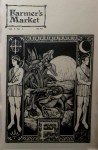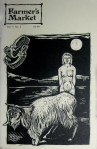
Jean Lee was an amazing artist, writer, editor, and human being. I first met her when I was a student at Knox College and she was the technical advisor for Catch, the student literary magazine. She taught me most everything I know about editing and design. Later, after I had worked in Chicago for a couple of years and was returning to reality after an extended European trip one summer and fall, Jean and Robin Metz took me in. Jean offered me a job typesetting the mammoth Siwasher/Catch Alumni Edition and helping with typesetting and layout of Farmer’s Market, a regional literary magazine that had developed quite a reputation after she took it over. That is when I became acquainted with Jean’s graphic arts work on the covers. The series was to extend through the alphabet, though unfortunately I never collected more than the ones I’ve posted here as a tribute to her life and creative genius. I would love to see more of those covers, if anyone has them. I’m not positive whether she was able to complete the series of linoleum block prints before circumstances caused her to give up the magazine and leave Galesburg. I regret that I didn’t maintain contact with Jean in recent years. She was a wonderful person and a gifted artist. Our world is poorer for her passing.
Where do we go from here? One faculty member’s perspective
[The following is a column originally printed in the Commercial Dispatch, Columbus, Mississippi, on Sunday, February 7.]
I ended a recent letter stating MUW needs to look to the future and be proactive. The issues of changing our name or merging with another university appear to be behind us for now, and no matter what our positions have been, we must face the reality that we remain Mississippi University for Women. We are capable of facing the tough challenges ahead, so the question that will determine our future is: How? I believe we must stick to our mission and capitalize on our strengths.
Clearly, the budget is our most pressing issue. We must work diligently to assure fair and adequate funding from IHL, including a funding formula that does not discriminate against small teaching universities. MUW and any other university in this category must receive the small school supplement because we do not have access to as many grants, we do not have graduate students to teach our classes, and we do not have the economies of scale of the larger research oriented institutions. Yet the small schools serve a segment of the population that would not succeed in a large university environment. MUW has the smallest enrollment in the state, yet we are currently denied the small school supplement. This situation must be rectified.
We must also join alums in a capital campaign to raise private funds to offset some of the losses in state revenues due to the current budget crisis. Donations to our general fund will help us meet our immediate needs, and donations to scholarships will help offset increases in tuition, which MUW has requested along with the other IHL institutions. Higher tuition will not hurt our students, if we can help them find more financial aid to help cover the costs.
Maintaining access to higher education must remain one of MUW’s primary goals. Despite tuition increases, MUW remains the best value in public or private colleges in the state. In order to improve in this area, we also must find new ways to reach segments of the population who haven’t had access to higher education, while maintaining our unique mission.
Online education has been promoted as one way to “save the ‘W,” yet it seems unlikely that MUW will become the next University of Phoenix. One of our strengths is our small campus environment. which does not fit with a large online presence. Yet students are more likely to have full-time jobs and families. They are used to online classes and they demand some online options . Yet MUW must be careful how we implement them. Rushing into a major online presence would be detrimental to our image and our mission, and we may not be able to compete with other institutions who have a head start in this area. We must continue to develop the highest quality online or hybrid programs and classes that offer flexibility and a personal approach. Students will choose a class that is well organized over one that is not. They will choose a class where the instructor communicates with them and answers their questions promptly. And they will choose a class from an institution with a reputation like MUW’s.
To maintain and polish our reputation, MUW must reaffirm its mission as a small, liberal arts and professional university with a woman’s emphasis. It is easy to claim a woman’s mission, but it is another thing to define what that is and to show that it is still valuable. Many of our alumnae have extolled the benefits they received from attending MUW. In comparison to other women in their graduate programs and professions, they report they are more empowered to take part in discussions and participate in their fields. They do not even consider taking a back seat to their male colleagues, while many of their female colleagues do. Women students at MUW have not been coddled or protected. On the contrary, they have been challenged to succeed in ways that are not as available in traditional coed institutions.
It is true that MUW admits men, and the number of male students has steadily grown. Clearly these men find value in a university with a woman’s emphasis. As we reaffirm our woman’s mission, we must also evaluate how we can best serve this part of our demographic.
Men as well as women benefit from small class sizes and personal attention from faculty and advisors. Beyond the small college experience, our male students benefit from a woman’s emphasis where issues of gender are at the forefront, and men benefit from learning in a collaborative teaching environment. The men at MUW learn valuable skills for working with women in leadership positions, which are skills they will need in a modern work environment where more women are becoming managers and executives.
MUW also offers leadership opportunities to men. We have had male Student Government Association Presidents and officers. We have fraternities, and our male students are active in other student groups. Men at MUW do not take a back seat to women, but they also do not assume they will take the front seat. In many ways, men at MUW learn to compete and cooperate better than they would in an environment where they still have an advantage because of their gender.
MUW must market itself as the right choice for both men and women because of its woman’s mission, not despite it. To do so, MUW must tout its successes. We must let the world know about our alumnae and alumni who have gone on to successful careers. We must also promote our many successful programs, from art exhibits and auctions, to music concerts, theatre productions, and literature conferences such as the Eudora Welty Writers Symposium and Tennessee Williams festival, and to our excellent programs in Education, Nursing, Culinary Arts, and Business (to name but a few and leave out too many). MUW is a vibrant campus serving the needs of its students and benefiting the community at large, and too often we are too humble about our accomplishments.
Finally, MUW must reaffirm our woman’s emphasis by engaging in a dialogue about how we define it and why it is vital to the MUW experience. This must not be a topdown process, but must come from our three main constituent groups: faculty and staff, students, and alums. These three groups, more than any others, must define our future. Our alums are our link with the past and tradition, but they are also our first line of support and they are committed to our future. Our faculty and staff, including administrators, represent continuity. Many of us have been here a decade or more. We are engaged with students every day, and we all participate in the governance of the university. Our students are our present and our future. They can best tell us why they chose MUW, how it meets their needs, where we need to improve, and what our prospective students want and need. Only a process that truly engages the university community as a whole and from the ground up will have a chance of uniting that community and renewing the strength we need to face the challenges that lie ahead.
Vegetarian Hutsepot: Warm food for a cold night!
A winter storm with up to an inch or two of snow is predicted to hit Mississippi tonight. People were already in the grocery store stocking up, when I stopped after dropping the kids off at school (we just needed a normal grocery run), talking about the possibility of being stranded for a few days. That always makes the Iowan in me smile, but temps are low for Mississippi, and may get down into the single digits. It’s a good time of year for comfort food, which has me thinking of our time in Belgium and one of our favorite winter dishes Flemish ‘hutsepot’ (the Dutch version is a little different, as is ours!).
There are many versions of hutsepot online, but the basics are a warm, white stew with lots of meat, beans, potatoes, and carrots. There have to be two kinds of meat, and as with lots of stew the cut isn’t always the best. The version made in Ghent that I ate before becoming a vegetarian had mutton, beef, and pork, maybe veal. That was the dish I wanted to replicate without the meat when we were living there, and though I’m sure many would consider it sacrilege, this is what I remember we came up with.
Essentially you take carrots and potatoes and cut them up for stew. Start with a leek or two and sautée it in olive oil or butter, then add several Belgian endive (witloof), if you can get it. I’ve seen Savoy cabbage substituted, but it doesn’t have the same slightly bitter flavor. Still, it would be better than regular green cabbage! We’ve used Chinese cabbage in a pinch. Sautée, adding potatoes, carrots, and white beans (1 can or about half a bag (cooked), depending on how much you’re making). Add salt, pepper, spices (bay leaf is often used), and water or stock and let simmer until it’s very thick. Towards the end, add some milk and cheese. We prefer Gouda when we can get it. In Belgium, we usually used a mixture of Gouda, Emmenthal, and one other cheese that came in a bag, was very cheap, and already grated. Tonight I’m sticking with Gouda, but Swiss would do pretty well, if you don’t want to splurge.
Anyone who knows me, knows better than to expect precise amounts. I bought half a pound of Belgian endive: more might be nice, but it’s expensive in the states. I’ll probably use two or three potatoes, depending on the size, three or four carrots, a leek or two, and as much cheese as I care to grate, depending on taste and texture. This one-dish meal would be good served with a nice warm baguette. We’ll see if I get that industrious! Then we’ll sit back, enjoy, and wait to see if they cancel school before the first snowflake falls… (of course, there could be ice, too).
Resolutions for 2010
December was a month for family (and finals), and I fell behind in my blogging. That’s all right, though. Family is important, and time away from technology can be time very well spent, especially when travel is involved. So I have a few resolutions for the new year: getting back to the blog is only one… continuing to spend time with family is another, and finding time to write poems (and send them to magazines) is a third. All will be a challenge this spring, since in addition to my full teaching load, I have a conference presentation at AWP and the Southern Literary Festival to organize for April 22-24 at MUW.
Christmas was a great time, though! Posole with my sister’s extended family (and our family) in Albuquerque was a great twist to the tradition. We usually have it in Iowa, but this year everyone went to New Mexico to be with my sister while she was having chemotherapy treatments. Fortunately, she had changed medicines and was feeling better and well enough to host us around town. Trips to Old Town and to Acoma Pueblo to see the Christmas dances on Dec. 26 were highlights. Deer and Buffalo dancers in the old mission church, now the pueblo’s public kiva, were highlights. It was moving to see the Acoma doing traditional dances, not for tourists (though we were allowed to watch and even encouraged to participate in the festivities) but primarily for themselves. Men with deer antlers on their heads and their faces covered in evergreen branches or men with buffalo hides covering their heads and shoulders were joined by young boys, girls, and women dancers, led by excellent drummers. It was certainly a celebration of their culture and community that inspires us to value family and community in our lives as well.
Happy 2010 — may your lives be filled with good poetry, art, family, and friends.
Making Money


Recently, I’ve been designing money — not real money and not Monopoly Money, but W Dollars to help show the economic impact MUW has on its local community and state. The idea is that any time someone from the W spends money, they should give a W Dollar with their payment: that might be a purchase in a store, gas station, or restaurant, or it might be for paying the rent or other bills. Students, faculty, and staff live in the area and we spend money here. We also save money, and could include a W Dollar when we make a deposit or put a W Dollar in the offering plate at Church or when we make a donation to a charity. If MUW is merged, there may be a campus in Columbus, but many of the students and faculty will have to move — either to Starkville or even further away, depending on what happens to our jobs or where we decide to go to school. These dollars won’t be spent in our community if we aren’t here.
The university itself brings about $17 million in state money to the area, much of which gets spent locally. In addition to the state appropriation, students pay tuition, we receive grants, and alums and other donors contribute to scholarships and the general fund. Futhermore, MUW alumns are leaders in their fields and add to the economic impact to the state. Many attribute their success to the education they received at MUW. MUW Graduate Dollars honor this aspect of MUW’s legacy.
For those who would like to print their own W Dollars, here are two files with 6 bills per page (please print front and back).
W Dollars with Lines for Cutting
W Graduate Dollar with Lines for cutting
Poetry and Politics
This has been another busy week, which is to be expected, since it’s the last full week before finals. What I didn’t expect (until recently) was the news of Governor Barbour’s proposal to merge MUW with MSU. This has put everyone in high gear to respond and keep up with classes!
I’ve laid down the poetry pen and picked up the letter-writing pen this week, with a couple of letters to the editor of our local paper. The first was in response to an editorial on “denialism” and the second to several letters pronouncing the death of MUW and an editorial about how Grandma needs to get out of the kitchen. This has me thinking about the connections between politics and poetry.
I haven’t written a poem about the merger yet, and I don’t know if I will. Sometimes letters are the most poetic form for the message that needs to be said, though if the occasion arose (a demonstration or other public event where a poem might be fitting), then I might see the point of writing a poem. I have written political poems, though, and some have even made it into my books. “Reflections on Tora Bora” is one, and I kept it because, though the initial situation that inspired it was long over by the time the book came together, I felt it spoke to bigger issues that the book also addressed: what it means to be an American, how we use language to name our weaponry, and our history of violence and war. Maybe I haven’t written a poem on the university merger proposals because I haven’t connected them to a larger issue yet — or maybe it’s just because I’ve been too busy with other forms of writing to process it as poetry.
I did get a chance to read poetry in a political context this week, however. I had already been asked to speak to the Lowndes County Chapter of MUW’s Alumnae Association, which I was happy to do. Their meeting was this week, a few short days after the Governor announced his budget, and after I’d published one letter to the paper and submitted the second. Reading poems in this politically charged environment automatically became a political act, so I chose to read “Spring Beauty,” written about another completely different political situation (or several on both the world and the local stages). It ends with the image of spring beauties, wildflowers, as a symbol of resistance to oppressive forces in the world. Several other poems that I read, which I don’t think of as overtly political, can be seen in the same light. The natural cycles of death in winter and renewal in spring inspire resistance to the destructive forces around us, even as winter poems can inspire an acceptance of the things that can’t be changed. Death can’t be avoided forever, but college mergers can be resisted right now.
What I’m getting at is that any poem or any strong statement is political in the right context. The beautiful poem that is simply beautiful when ensconced in a literature anthology, may have begun its journey with a more political intent, and regardless of the original intent, when taken out of that context and placed in the real world, it can have a political effect. The act of writing poetry is in some historical situations a political act, and I would argue in any situation it can be political. That is why I’ve never bought the artificial distinction between poetry (supposedly apolitical, disinterested, neutral, more than likely masculine) and political poetry (which is somehow deemed inferior, as if the desire to have an effect with what you write is somehow a flaw). If poetry is powerful language, then it must by definition have the power to move and therefore must be political.
But sometimes letters are what is called for (or Declarations, Constitutions, or Addresses — I heard on the Writer’s Almanac that yesterday was the anniversary of the Gettysburg Address, a political prose poem of the highest order). But now I’ll probably have to write a political poem after all…
Just say No (to merger)
First a bit of history…. a little over 15 years ago in June, when I was a relatively young grad student who had just defended his dissertation and was out on a job interview, I awoke to the public radio station reporting news of a planned merger for the school where I was about to interview. This was a little unsettling, to say the least. The school was MUW, where I’ve been teaching ever since.
At my interview with the division head (we had 8 divisions then, instead of 4 colleges), I timidly asked about the news. “Oh, that will never happen,” Ginger Hitt reassured me. And she was right. Then, as now, the alums of Mississippi University for Women went to bat for their alma mater. Then, as now, they wrote letters, made phone calls, made personal visits, and made it clear that the first state supported university for women should not be closed or merged.
Today we face the same threat, this time ostensibly due to the current budget crisis, though there is little evidence that merging MUW (and merging Alcorn, Valley, and Jackson State) will have much of an effect on the budget. When there are financial or other difficulties, someone always seems to call for closing the traditionally African American universities and the women’s university. It just so happens that we are also the smallest universities in the state. Never mind that many students are better served in a small, teaching university than in a large research university. Some will always believe that bigger is better, but for many students who need a more personal education, it is not. Our successes can be witnessed by the passion and political savvy of our many alums, who have already begun to mobilize in our support.
Fifteen years ago, I wouldn’t have guessed I would still be here and would be facing the same threats again. But I have grown to love the W and to respect what it stands for. I have worked hard over those years to be a part of what makes this university great, and I have seen the tireless efforts of many others. I would hate to see that legacy lost if MUW were merged with Mississippi State, as Governor Barbour proposed in his budget today. We would lose our identity and many of our core faculty, if that happens. Our students would lose the opportunity to learn in the environment that best fits them (if it didn’t, they would have chosen one of the larger schools). I have heard from many of my students and from many alums who have told why MUW was the right place for them at that point in their lives.
That is why they support us — because we offer an educational opportunity that can not be matched or duplicated, and it has made a difference in their lives. They have already organized two meetings, on in Jackson yesterday and one in Columbus next Sunday. My hat is off to the long blue line!
Afterglow (or is it sleep deprivation?)
Well, the 21st Eudora Welty Writers’ Symposium has come and gone. Each author’s reading was great, and my only regret was that I couldn’t be two people: one listening calmly and hanging on every word and another who could run after batteries for the failing sound system (we did get it replaced, thanks to Mack who came in on the weekend to rescue us!), pick up the picnic lunch (we had a beautiful day for this and a great time with a group of alumnae who stopped by), take credit card receipts to the comptroller, deliver the Dilettanti/Ephemera/Oh Lady! Retrospective, and take care of all the other little details that invariably come up during an event like this.
Now it’s time to get back to reality and catch up on sleep and grading. Yesterday I counted the cash from the book table; this morning, I’ll go in and count the books. There’s always plenty to do after the fact. But a little of the magic remains in the memories of the weekend and the comments people send.
My favorite times, besides the moments during the readings when I wasn’t thinking about the next thing that had to be done, were the meals — not just because of the food, but because they gave me a chance to relax a little and converse. Taking Becky Gould Gibson to the Kountry Kitchen was great, and we both enjoyed and want to replicate the squash dressing we had. Lunch at the Back Door was great as always, and we had a relaxing hour at Dr. Limbert’s house before going to a really excellent series of one act plays put on by MUW’s Theatre department (which will be in full production this weekend — don’t miss it, if you’re in the Columbus area). The picnic was grand, and would have been more relaxing if the local TV news hadn’t shown up and wanted to interview me — for which I am grateful!
Saturday night was really the best for us, since we could finally relax. Dinner at Profitt’s Porch with Becky Gould Gibson, Ken Wells, Jack Riggs, and Tony Earley was lots of fun — great food and a quiet setting. We even saw deer, a fox, and an armadillo on the way to and from the restaurant out in the woods. And then the party back at our house with the authors and a few students and recent alums all gathered around the fire pit on our patio. The weather was just right for a fire and we had a great time.
Now that it’s all over and I can soon start planning for next year (and the Southern Literary Festival this spring), I can also get back to the regular subjects of this blog — poetry, nature, food, travel, etc. — normal life in other words. It will be great to have life get back to normal, but I wouldn’t miss a weekend like this for the world.
T Minus 6 and Counting
Six days from now, the Eudora Welty Writers’ Symposium will begin. In the meantime, I’ll have lots to keep me busy, but the main tasks are taken care of. Now it’s down to tying up loose ends and getting everything ready. The perfect time for a little preview or two. I’ll be giving one, a reading of my poems, on Sunday, October 18, at the Tennessee Williams Birthplace and Welcome Center on Main Street in Columbus. I promise not to repeat myself, so don’t be shy about coming out! The reading starts at 2:00 p.m. and lasts until 4:00 with plenty of time for questions and refreshments.
This morning, I had coffee with Melissa Delbridge, who is in town for the Common Reading Initiative and the Welty Symposium. She is as delightful in person as you might expect from reading her memoir, Family Bible. We talked about writing and publishing, and I learned her book was picked up by the University of Iowa Press after their editor spotted three of her essays in Southern Humanities Review. We agreed that the old adage that you need to publish in little magazines first still is true. I’m looking forward to having more time to spend with her this week, and I know our students in the Honors College and UN 101 will enjoy meeting and talking with her.
In my poetry class we were reading Frank X Walker last week. Walker was a revelation for them, I think. They responded well to his declamatory style in some of the poems and his ability to pull the reader in and take them along for a ride. We discussed voice in his poems and were awed by the different voices he could take on. Some had read his Buffalo Dance in another class and talked about how he took on the voice of York from the Lewis and Clark expedition. We are looking forward to hearing him read his poems aloud next week.
Busy Week
It’s been a busy week around here, what with trying to get lots of details wrapped up for the Eudora Welty Writer’s Symposium. Our press release is now out, flyers are printed and distributed around town, the last of the authors’ travel arrangements are taken care of, and I”m nearly done ordering books.
Oh yes, and then there is the food (check!), the arrangements of tables and chairs at our location (next week), the online program (check!), and the printed program (nearly complete). Then there’s the little detail of a retrospective issue of the Dilettanti, Ephemera and Oh Lady!–student literary magazines MUW has produced over the past 102 years. Thanks to the scanning marathon conducted by Bridget Pieschel, we have plenty of text to work with. My job this week (extending well into the weekend) is to enter that text in our publishing program (InDesign) and get it to our printer in time to have it back by Oct. 23. Should be fun…
I shouldn’t forget those pesky classes and grading. Keeping up can be a challenge that makes you sympathize with your students around midterm time. In Poetry Workshop we were talking about personal poems and whether a poem should be about the poet. Not surprisingly, most of my students felt it should be. Maybe I’ve convinced some of them that it doesn’t have to be and that when it is, the choice is not so simple as it seems. There are so many ways a poet can include him or herself in a poem — as the subject, as the mind behind the poem, as a ‘persona’-like character in his or her own work, as a barely present observer whose personality is hardly important, though it informs the way the observed world is portrayed. Undoubtedly there are more ways to do it or there are combinations of the above. I don’t mind how students write, as long as they are conscious of their choices and struggle with them somewhat.
Our son, Aidan, has also been busy, working on the National Anthem, which a group from his school will sing at the high school football game soon, auditioning for a play, and going to 3 soccer practices (thank goodness the rain finally stopped!), violin lesson, fiddle lesson (the first one of the fall), and orchestra. Thursday we were dashing to three activities in one afternoon. From what we understand, it will only get worse as he grows up…