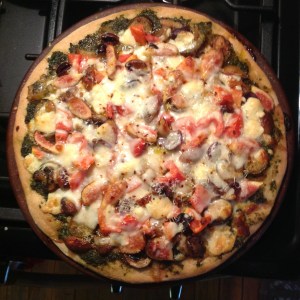
Fig Pesto Pizza

IMG_0624We have another bumper crop of figs this year, and since we don’t make fig jam or fig preserves, we are always on the lookout for good ways to use them. Sure we freeze quite a few to enjoy later in the year (just wash, let dry, and freeze whole), but we love eating them fresh, both raw and cooked as part of the meal. Figs are very nutritious and combine well in a stir-fry or our favorite, fig and gorgonzola pasta.

This week, Parade had a recipe for fig and prosciutto pizza, but I had already been thinking about using figs on a pizza. Since we’re vegetarians, I ignored the prosciutto recipe and came up with one of my own.

I start with a basic pizza dough recipe, which is essentially half a cup of water, yeast, flour, oil, sugar and salt (for two people). I disolve my yeast in the water, add a little sugar or molasses, then stir in enough white flour to make a muddy paste (the sponge of bread). After stirring this awhile to build up some gluten, I then add about a Tbs of olive oil and a dash of salt, then add whole wheat flour to make a soft bread dough. Coat the bowl with a little more oil, cover and let rise for at least half an hour before pressing out on your  pizza stone or pan. Or you can buy premade pizza dough, but homemade is so much better.

For the sauce, I sliced half an onion in rounds or half-rounds, then sautéed with a little garlic in olive oil until translucent and a little carmelized. Then I added mushrooms and a little asian eggplant, though you could leave them out if you prefer, along with a few chopped up figs and the juice of a tomato.

Tip: The tomato juice is a litte trick I use. When I want to use fresh tomato and don’t want it to be too runny, like when I add chopped tomato on top of pizza or on tacos, I quarter it, then squeeze the seeds and juice into whatever I’m cooking, so I don’t lose the flavor. The juice cooks down, and I”m left with the solid parts of the tomato, which I can then chop up, reserving to add raw at the end so they won’t cook too much and get mushy.

The pesto forms the base layer of this pizza. It’s just pine nuts, garlic, and herbs (for this, I used basil, oregeno, and rosemary because that’s what I had and I wanted a spicier pesto than basil alone would be—arugula would also work well). I chopped this into a paste in our mini food processor with enough olive oil to make it a paste. I did not add any parmesan, which I normally do with a pesto, but the cheese will be on top.

Spread the pesto evenly across the pizza, then add the onions, etc., on top of that. Then add quartered figs, chopped tomato, and kalamata olives. I used about 2 oz. of gorgonzola cheeze (leftover from our last fig pasta), a little mozzarella, and some parmesan. Bake for about 20 minutes at 425 degrees (or until done), and enjoy!

My First Decade as Occasional Blogger

Screen Shot 2019-07-23 at 10.01.10 AMRecently, WordPress was kind enough to inform me that this month is my 10th aniversary of writing this blog. As I looked back, I noticed the very first first post was July 24, 2009. What a long, fun, and a little crazy trip it’s been.

I started blogging mostly as a dare to myself. I’m a poet, and writing a blog seemed like a good way to give myself some writing goals that didn’t have to be poems. I didn’t expect to write daily or even weekly, as most blogging advice tells you to do. I also decided that I wouldn’t stick to just one subject, though that is also good advice.

What I wanted was an author’s website and blog, and I wanted to write about all aspects of my life, including poetry and teaching. Writers are people, too, and I wanted my blog to reflect that. So I went along for quite awhile, quietly blogging about poetry, teaching, food, etc., and I was getting a few people viewing and even following the blog now and then. My stats were modest, and I was fine with that. It was a good outlet for my thoughts, and that was enough.

1946motorette-croppedOne of the first posts that took off unexpectedly was one I wrote about my father’s 1946 Motorette motor scooter. I wrote it mostly as memoir and to chronicle something from my childhood that my mother was thinking of getting rid of. I didn’t really expect to sell it, but someone contacted me, one thing led to another, and we sold it — not for a lot of money, but to a new home where it would actually run again (and my brother even got to ride in it once, since he lived not too far away). That’s a post (along with its follow-up about the sale) that still gets a hit now and then, and it may be the post that has gotten the most comments over the years. People want to know where to buy one or where they can sell one. When I can, I try to point them in the direction of a group who may know.

But the biggest surprise post I ever wrote was the rant about my DSL modem from ATT. This is a post I wrote in May of 2013. It got a few hits at the time, but eventually started picking up steam, probably because someone linked to it. For awhile, it, along with a series of follow-up posts, was driving over a hundred visitors to my blog every day. Following on this popularity, I wrote more about technology for awhile, including some posts about my trackpad and our smart TV that still get the occasional hit.

Barrier Island Suite front cover imageBut after awhile, I wanted to bring the blog back closer to its original focus and began posting more about poetry again, especially with the launch of my third collection, Barrier Island Suite. The publication of my textbook, A Writer’s Craft, and the beginning of The W’s MFA in Creative Writing led me to post more about creative writing pedagogy. And yet, some of my other most popular posts are on cooking or buying and selling a car. Sometimes it’s hard to predict what will resonnate.

Over the years, I’ve had periods when I didn’t have time to blog much and times when I posted fairly regularly. I’ve written a lot about food, and have always been suprised at the popularity of buttermilk, which I first wrote about feeding to our dog when she was very sick, but later included in many of the recipes I’ve shared. It’s one of my standard ingredients for which I’ve found a lot of uses. As a cook, I’m as eclectic as I am as a blogger. I rarely follow recipes and use the blog write down what I did for myself as much as for anyone else, but the recipes I post tend to get a fair number of hits every now and then.

I’ve also used the blog to memorialize some of the teachers and friends who have passed away over the years. As long as I have a public forum, it seems right to use it to pay tribute to those who have contributed to who I am, both as a writer and as a person.

Book reviews are another category I’ve tried to come back to fairly regularly. I read a lot for class, and usually don’t review those books, but I try to write at least a few reviews of the best books I read for the Eudora Welty Writers’ Symposium: expect a few more of those in the coming weeks as I’m very excited about the current slate of writers. Still, I probably won’t find time to review them all because there’s lots of planning to do just to pull off the event!

I’m glad to see that writing is still the category I’m most prolific in, even though technology has certainly brought more people to my blog, and MFA advice is another category that is taking off, thanks to some outside links to my posts. Recently one reader commented that she first came to get help with her modem, but has kept coming back for the writing. I hope that’s true for some of you, but whatever brings you here, if you find something that’s useful or just entertaining, then I’m happy. I plan to keep writing, keep cooking, and occasionally keep ranting about technology or posting about a fix I’ve uncovered for a problem that I’m having. I’d like the blog to be moslty about poetry and creative writing pedagogy, but as an occasional blogger, I know I’ll probably write about whatever’s on my mind when the mood strikes me and I can carve out a few minutes from my day to write it down.

Thanks for reading this, and for following my blog if you do. It’s been a great ten years; here’s to the next decade!

Keeping the Res in Low-Residency MFA

DSCN9898As our low-residency MFA program enters its fifth year, it seems like a good time to reflect on where we’ve come and how we’ve evolved, and that includes why we’re committed to the low-res format for the degree.

Our program is different from many low-res MFAs out there because we follow an online class model. AWP, in its Hallmarks for Low-Residency MFA programs, oulines three types of program: ones with mentoring, ones with electronic classrooms, and hybrid. I’ve never met a hybrid program, and most of the well-known low-res MFAs out there seem to use the mentoring model, but I assume there are others using online classes, since the model existed before ours was created. Still, a lot of programs and prospective students seem to expect the mentoring model. Our students are usually glad to have the online class model because it means they have contact with each other outside of the residency periods. But for some, it begs the question: why do I even have to come to campus? Usually, once they’ve been here, they understand.

There are fully online MFA programs, of course, and those can be our competition. But there are things you can’t do online that you can do in a residency: have meals together, have and give readings, talk face-to-face in workshop groups and socially, complain about the air conditioning or the dorm beds (hey, nothing is perfect), get up early (as Kyla is famous for doing when she’s here) to go to the wildlife refuge, or stay up late together hanging out at local restaurants, etc. We have parties, and we bring coffee cake to workshops.

And in our program, we have multi-genre workshops in the summer, where fiction writers sit across from poets and beside playwrites or memoirists. We get out of our comfort zone and learn from each other, and our workshop leaders are not the same people who taught us during the semester and may even write in other genres than we do. This, combined with the afternoon seminars on practical aspects of being a professional writer and evening readings by students, thesis candidates, teachers, and guest writers helps us form a strong sense of community even though we are spread out all across the country (and in Europe). The online class format with regular video conferences helps with this as well, but being together for 10 days cements that feeling, energizes us, and gives us connections that will last a lifetime.

That’s the full-residency experience, but when we put the program together, we realized we also wanted some shorter experiences, too. We wanted to have times when we could recharge our batteries in four or five days and offer unique experiences. So we also instituted short residencies. The most logical one was at our Eudora Welty Writers’ Symposium, where students come to hear a dozen recently published writers at this annual event that is now in its 31st year. With a great writing event like this on campus, it only made sense to incorporate it into our MFA program, but since it happens in October and is for the community and the undergraduate campus as well, we knew it had to be seperate from any of our online classes.

Other short residency experiences that we’ve developed since then have focused on the business of writing or on another artform. The first summer short residency was led by our drama professor, T. K. Lee, who led a 5-day session in acting for writers. Students wrote their own short scripts adapted from something else they’ve been writing, and then acted in each others’ plays. We’ve also done one on oral storytelling and one on songwriting and music (and we repeated the acting residency once). Each was a great experience: a little intimidating at first for some, but in the end a great bonding experience and an opportunity for growth as an artist.

The other short residency that we offer is in the spring, when we take a group to the AWP conference. This is full immersion into the professional world of the writer, and it is also overwhelming, exciting, and incredibly rewarding. We spend a fair amount of time in our online class before the conference getting prepared: poring over the schedule, talking about what panels and off-site events people want to go to, looking at what bookstores or other local hotspots we definitely want to see when we escape AWP, and plannign what we’ll say about our writing and about our program and literary magazines when we’re walking the book fair or working our table. Then we arrive at AWP and are immersed for the three-day conference, trying to get together as a group a few times, though often we end up coalescing in smaller groups or seeing each other in passing.

When the program was begun, we knew this was the basic format we wanted to go with. We said (and continue to say) that we were flexible and want to work with students so they can have a low-res experience whether they can come to campus every semester or not. And we’ve managed to do that very well. We encourage everyone to come early in their program and to come back whenever they can, and generally that’s been doable, but we’ve had some students go a year or so without coming to a residency, yet they are always glad when they can return.

The other thing that has kept us flexible is adding new classes like the literary magazine production class and the internship class that allow us to give students professional experiences that will help their writing. In response to student requests, we’ve developed classes like Professional Writer, a (primarily) fiction class aimed at helping students revise and submit their work to literary magazines, and we’re planning to do a section of it focused on the long form: novels and full-length memoir. We’ve added special topics classes to address themes that students or faculty are interested in, and we keep exploring ways we can grow.

One of the most exciting developments this year will be collaborating with the theatre department’s new low-res MFA in Theatre Education program. We will have some of their students in our drama classes, and we are looking forward to the ability to offer some of their practical theatre classes (directing, stage design, etc.) to our playwriting students. And we’ve already been collaborating with theatre to produce staged readings of some of our student plays. Now that they’ll have a summer residency, too, we may be able to stage full productions of some of our scripts, and we may be able to offer a theatre residency or a short independent residency class for a resident playwrite.

Our first four years have been fantastic, and I’m looking forward to what the fifth year will bring. As always, our goal will be bringing the most rewarding experiences we can to all of our students and combining the flexibility of online learning with the benefits of face-to-face experiences.

The Best Little MFA

It’s been four years since we started the low-residency MFA program in creative writing at Mississippi University for Women, and in that time, I think we’ve created the best MFA of it’s size around. Of course, I’m biased, and I’m grateful to the students and faculty of our program who have been so great to work with.

We’ve now graduated 15 MFAs (counting the five who’ve defended their these and will get their degrees in August), and we have an enrollment hovering around 40, which is right where we want to be. We started with three faculty, two of whom were part-time, and now have three full-time faculty, one who prefers to teach 2 classes and direct theses and so is still part-time for now, and several regular part-time faculty who teach one class per semester. This allows us to offer a wide variety of classes and serve the varied needs of our current students. And it allows us to have enough faculty to direct theses as students move from taking coursework to the thesis stage. We’ve seen theses in each of the genres we focus on in the program: fiction, poetry, creative nonfiction, and now drama with our first playscript as thesis defended in June.

What makes me think of our program as the best, though, are our students. We have a great, diverse group who work well together. They are writing in different genres (and some writing genre fiction or young adult), yet they provide a supportive environment in our online classes and when they get together at residencies. The energy in the building (despite this year’s headaches with A/C issues) has been fantastic. Every night at a full resicency, we host readings, featuring a faculty member or guest writer, a thesis candidate, and two or three other students at the residency. Our thesis students give great readings, are confident, and show they are ready to move into their professional careers. But the shorter readings by other students are fabulous, too. Here students take risks, sometimes reading for the first time in public, and the work they present is polished and compelling. You’d have to be there to know what I mean — and you could be, since they’re open to the public and we often have guests from town or beyond.

Besides the readings, I know our students are killing it through there publications. Hardly a week goes by without at least one notice of an acceptance from a student or alumn. We’ve had an AWP Intro Journals prize winner and an honorable mention, and our writers are getting into some great publications. We already have one graduate with two books of a three book deal published, and a poet with a micro chapbook and good leads on a full-length collection. And I expect more good news soon, given the strength of the theses I’ve seen.

I try to keep up with the all these accomplishments on our Facebook group, then periodically I ask students and faculty to send me their publications (I’m afraid I will miss some things on Facebook and Twitter) and list them on our accomplishments page.

I know there are more established and more prestigeous programs out there, and many of them do great work by their grad students. But if you measure the value of a program by the dedication of the faculty to teaching and by the cameraderie of the students and the writing (and publications) that this fosters, then we have a lot to be proud of. We’ve accomplished a lot in the first four years, and we’re looking forward to an even better fifth year.

That said, how would we like to improve? For one, I’d love to attract an even more diverse student body. We’ve been fortunate enough to attract African American, Asian American, Latinx, and LGBTQ students (and faculty). We also have students from all over Mississippi, every US time zone except Alaska and Hawaii (so far), and even a student in Italy (for now). We have students from all kinds of backgrounds and religious and political persuasions, yet everyone tends to get along very well because the writing is what really matters. Together, we have formed a great community, and to me, that’s what makes us the best little low-res MFA out there.

Facebook, You’re Such a Nag

Or Why writers Should All Say No to Constant Content

I don’t know about you, but I manage several groups and pages on Facebook, and one constant source of annoyance is the notifications that my readers haven’t heard from me in awhile. The only thing more annoying are the ones telling me a post is performing better, so I should pay Facebook to advertise it.

Let’s consider the logic here. Facebook’s business model is to get people on their platform because we enjoy sharing our news with others. But that isn’t enough for them. They know they have billions of free content creators, so they constantly remind us that they need us to create the news, entertainment, memes, personality quizzes, challenges, and other mindlessness that will keep their users coming back. Then they use algorithms to control what we see and convince us that we need to pay for ads, so our posts will stand out from all the drivel. They act like drug pushers, luring us in, then creating a need that will sustain their business. But the drug isn’t even real.

As a writer, I resent anyone who tries to get me to create content for free. If I’m going to do that (like I do on this blog), I want to do it on my own term and my own schedule. Often, I’m busy and don’t have time for Facebook. Or (like this week) I’m on vacation and don’t want to work, though I may respond to emails, etc. Or there simply isn’t anything I need to tell my “readers.” I want the content of these pages to be useful, informative, and timely. When the people who like my pages see my content, I want it to be something they want to read, not something they choose to ignore, so I resist Facebook’s near constant reminders.

Twitter, for all it’s flaws, is much better in this regard. It is more laissez faire. Twitter could care less when you post or even whether you post at all. Yes, you can buy an ad, but Twitter doesn’t seem to give a hoot whether you do or not. Maybe they’re just that much bigger than their immature rival or maybe it’s part because of their lawless culture. Lawlessness has it’s own issues, but in this regard, it creates a more positive environment for writers.

I want to guard my time and to create time for my own writing. Rather than writing a post so Facebook can profit, I’d rather write a poem. I want to use social media on my terms, go there for the information I want, and provide content when it suits my needs, not so Facebook can profit coming and going. Until Facebook comes up with a model that pays writers for their content (don’t hold your breath), we should all be very judicious about the time we spend there, and we should ignore the nagging call to create more free content than suits our needs.

Facebook, I’ll write on my page when I’m damn good and ready. It’s more important for me to write a poem or hang out with my nieces and nephews or visit with my mother. Life is more important than Facebook, and my writing is mine. I’ll give it to the world on my terms and in my own time.

The Art of Implication: replying to emails

If there’s one thing I’ve learned over many years of replying to email as an educator and a literary magazine editor, it’s to take a deep breath before writing a reply and to imply the things I’d like to say. So you can imagine the reply I might have sent to the submitter tone our literary magazines who wrote to complain that we had returned a submission that was getting recognition elsewhere.

In my reply, I acknowledged that our review process is imperfect and subjective, and I mentioned some of the factors that can play a role, from the typos in a submission, to the length, to the themes that emerge as an issue of the journal comes together. I also encouraged him to read our journal to better understand our choices, and I defended our practice of offering a discount to all those who submit, even if their work is returned. What I didn’t say is that no one is obligated to subscribe, but I did note that we have back issues posted online with free access.

The advice I didn’t give, but I hope was implied, is that writing snarky responses to rejection notices rarely helps your chances when submitting to journals. Editors work hard and try to make the best decisions they can. We know you’ll be disappointed when we don’t take your work, but we expect you to develop a thick skin and not take it personally.

I could have said this explicitly, but I doubt the person who wrote would have taken it very well. Keeping the tone positive is more likely to get the desired result. Of course the other option would be not to reply. Sometimes no answer is the best answer.

Reviews can be Gratifying

Tonight I happened to look at the Amazon reviews of A Writer’s Craft and saw that there are now three: all from people I don’t know who have used the book in a class, and all three gave it five stars. So that made my night!

I promise, I don’t obsessively check my reviews, but I should be grading, so some procrasitnation is required. The earliest review is from March, 2019. I don’t remember the last time I looked to see if there were any reviews at all, but it was probably at least 4 months ago, maybe longer, and at that point, there were none.

Full disclosure, though: I also checked Goodreads, where there’s one two-star review. That person didn’t say why. I’m sorry the book wasn’t what they were looking for,

The reviewers on Amazon did write about the book, which was also great to see. I know that reviewers can be fickle and there will be negative ones mixed in with the positive, but it’s great to see that my book has reached real people and that a few took the time to say something about it. That means a lot, and I’m very grateful.

Transcripts for the MFA Application

I’ve reached Day 8 in Kenzie Allen’s 10-day course on applying for the MFA in creative writing, and she’s talking about the CV, transcripts, and the GRE. She has a lot of good advice, so if you haven’t taken her free course, you should. She even links to my blog a few times, so she must have done her research!

I agree with Allen about the CV — it should highlight your education and other experience, it should be professional and easy to read, and you’ll probably elaborate on most of those things in your letter or statement of purpose, but the CV brings them all together and is a place where you can list all of your publications (if you have them) without bogging down your SOP. At our program, it’s optional, so don’t stress about it, but do send one if it helps you make your case.

I also agree that the GRE has become less and less important. See if the schools you’re applying to require it, and don’t take it if you don’t need to. If you do need to report a score, remember that most MFA programs don’t care what your score is, but they may be required by their graduate school to use a minimum score as a requirement for admission. They may not publicize what that score is, and they may have some leeway in how they set that score (that will vary by university), but you’ll need to report it if they require it. Then the committee will likely ignore the score once they see you have met the minimum standard.

However, I realized that, though I agree with most of what Allen says regarding transcripts, I hadn’t written about those and there are a few things I can add from a program director’s perspective. For one, Allen says that in her experience it doesn’t matter if you have studied English as an undergraduate. While that’s true for many programs, I also know of some that require a certain number of prerequisite English or creative writing undergraduate courses. Usually, they don’t ask for specific ones, but a certain number of hours of literature. You might be admitted without these, but required to take them in addition to your regular degree requirements.

Our program doesn’t require any prerequisite English courses, and I’m happy with that. We’ve admitted a dancer and an accountant, among others. I’ve probably forgotten more of our students’ undergraduate majors than I remember, since once you’re in the program, it won’t really matter. But your transcript will still make a difference: it tells me things I want or need to know.

1) What you’ve studied

Naturally, we like to see that you’ve studied English, whether or not your major was in English. Many of my best creative writing students over the years have not been majors, so I’m open any major. If you never took an English class as an undergrad, that can be an issue (in terms of your preparedness for our degree), so I’ll want to see evidence elsewhere of your active reading life and of your sophistication as a scholar. After all, some of our classes demand that you do literary research, so you want to show you’re prepared. We also like to see undergraduate creative writing classes in the mix, but if you haven’t had that opportunity, we understand. Things like summer workshops or activity in local writing groups can help your application if you don’t have creative writing classes. So if your transcript has holes, you want to address them in your SOP by talking about what you’ve done since graduation. Most of the applicants to our low-res program have been out of school for many years, so their experience since undergrad should weigh much more heavily than their undergrade, except it does tell about your academic record.

2) How well you’ve performed in school

The one thing you can’t change is your undergraduate GPA, and that can be very important for admissions. Actually, you can change it by going back and taking some undergraduate classes or by enrolling in another graduate program. If your GPA is deficient and you’ve gained a lot of experience and motivation, you may be well-served by taking a semester or two, even part-time, to show that you can now do better than you did the first time.

For our program, you need a minimum overall GPA of 2.75 or a GPA of 3.0 in the last 60 hours of work in order to be fully admitted to our program. If you don’t have that, then taking additional credits might help you bring up those last 60 hours. We consider every semester in its entirety, so if your the 60th hour is in a semester with several other hours, I would have to consider the whole semester. Taking additional classes might even affect which semesters would be considered in your  last hours, which might help as much as earning higher grades.

(These requirements will likely be different for each university on your list.)

3) How you can be admitted

GPA makes a big difference in how we admit students. The choice of whether to admit someone hinges more on their overall academic record and what they’ve done since graduation. I’ve admitted students who were marginal at best during their undergraduate years, yet who had gone on to achieve remarkable things. I want to look at the whole picture, in other words, but I also have to consider your potential as a student and I have to live within the rules of my institution’s admissions policies. Check these out for any school you’re interested in, esp. if you’re worried about your previous record.

I can fully admit someone to our program if they meet our admissions standards or I can conditionally admit anyone to our program if I feel there are mitigating circumstances.

Conditional admission means that you are limited to taking two classes in your first semester (or three if you come to our 1-hour residency), and you must earn a B or higher in those classes to show you can handle graduate school. (You’re only allowed two Cs in your program, so to get one in your first semester would be a very bad sign. Why should we keep taking your money if you’re not going to succeed in our program?) Conditional students are also not eligible for federal loans, so you would need to pay for your first semester out of pocket or with private loans. But once you’ve proven yourself, you are then fully admitted and can study full-time and qualify for loans. I’ve had plenty of people do this and do very well in our program.

So, if you’ve had a rough patch in your academic career, know that we’ll understand. It’s probably something you want to address or even get your recommenders to address in their letters, but it shouldn’t be something that will stop you from earning your degree. You can tell us why you hit that rough patch, if you want to — sometimes it may now be exactly what inspires you to write — or you can simply acknowledge it and talk about the things you’ve done since then that show you can succeed.

If you’ve been a great student but in areas other than Engish, then acknowledge that as well and show us how you combine your other interests with your writing or tell how your journey took you to a love of writing.

Your transcripts are important documents that show your preparedness and your aptitude for scholarly work. They are not the end-all-be-all of your application, but they provide a unique window into who you are that is complemented by your writing sample, statement of purpose, and letters of recommendation.

We do need to see official transcripts from every post-secondary academic institution you have attended, whether you received your degree from there or not. (Some schools make exceptions for transcripts with fewer than a given number of hours, but many do not.) Go back over your transcripts (as I will) and look to see if you transferred any credits from another school. Make sure we have the transcript from that math class you took at community college, etc. Doing that on the front end will make things easier when it comes time for us to make our decision.

Revisiting the Statement of Purpose for the MFA

This week, I’ve been learning how to apply to MFA programs in creative writing: I decided to take a free course, even though I direct an MFA program. I’m taking the course to see what Kenzie Allen has to say about the process and to review what I think about it, since I’ve written a number of advice articles and our program’s Guide for Applicants. This morning’s ‘class’ (each morning for 10 days you get an email with advice on applying) was on the Statement of Purpose. It got me thinking about the importance of this part the application, which I’ve written about previously.

Allen has some good advice, and she links through to several articles by others about how to write a statement of purpose. They all pretty much agree, though each gives a slightly different take. There’s no one-size-fits-all advice for this, or the statement wouldn’t be personal. Incidentally at my program, we call it a Letter of Intent. We do that in part to make it seem less daunting, in part to make it paradoxically seem more personal, and in part to emphasize your goals. You’re not selling me on who you are; you’re selling me on what you want to do in our program (and that you are the person who can do those things).

What I was struck by in my reading this morning is just how important this letter is. Everyone says the writing sample is the most important, and that can be true, but the statement of purpose or letter of intent is just as big a deal, and it’s probably harder to write.

I’ve seen letters of intent that definitely got an applicant into our program. Their writing sample was competent, but not terribly exciting, but their letter was moving and read like very good creative nonfiction. I could see the potential in this writer from their letter, even though I could tell from their writing sample that they were still struggling to find that voice in their fiction or poetry. The letter showed me that I had someone who was ready to make that leap in their creative writing.

I’ve also seen letters that swayed me the other way. I’ve seen many that used the clichés every advice article warns against: all the permutations of “I was born to write,” for instance.  A few have been accompanied by writing samples that made me overlook the naiveté of a poor letter (yes, I know how hard they are to write!) and others that led me to believe the writer simply wasn’t ready for an MFA program yet.

I’ve even turned down one applicant, who wrote back an impassioned response defending themselves and arguing why they were ready and didn’t want to wait another year to reapply. I told them that this should have been their letter in the first place, and I allowed them to send me more writing. Eventually they were admitted to our program and are doing quite well. However, I don’t recommend that strategy!

We’re a small, young program, and so far we’re not overrun with applications. I can take more time with every applicant than the programs whose admissions committees see hundreds of applicants each admission cycle. We can give more personal attention, and so far, we can accept nearly everyone who seems to be ready for an MFA and who seems like a good fit for our program. That may change, and we may be faced with more difficult decisions. Yet even now, the statement of purpose/letter of intent is a very important part of your application, along with your writing sample. Those are the first two things we’ll see, and they form the basis of our initial decision whether or not to encourage you to complete your application and pay the application fee, send transcripts, and get letters of recommendation.

We want to know who you are and how you got to where you are, and we want to know where you think you’re going and why our program is a place that can help you get there. We want you to be as specific and detailed as possible, and we want your letter to be well-written, somewhere between a personal letter and a creative nonfiction essay. If you can do that, and if you send us writing that you’re passionate about that shows your promise as a writer, then the odds are in your favor.

The rest of your application confirms that you are who you say you are. It’s important, don’t get me wrong. But your letter and writing sample will literally give the first impression, and therefore, they carry the most weight.

Remembering a Mentor

This weekend, I drove from Mississippi to western Illinois for the memorial gathering of one of my main college mentors, Robin Metz. The many hours by myself in the car on the the way there and back gave me lots of time to reflect, and seeing so many people come out for the memorial was gratifying. Robin taught for over 50 years and was still on the faculty of Knox when he died. Only in his final semester did he take medical leave and not teach a class. Until then, despite treatments for pancreatic cancer, he continued teaching until the end.

Many of us made it back, and many more sent their condolences and greetings. Former colleagues of his were there, as well as family and people from the community. I went to school with both of his daughters, so I was glad I could make it and have a chance to reconnect with them. I’d seen Robin and his wife, Liz, several times in recent years, but hadn’t seen Lisa and Ronnah in quite awhile.

Friends who gathered after the memorial to talk, eat, and yes, even dance to the one eighties song we could get the DJ to play (Prince), have gone on to do many things. Some of us are educators, some work in different fields. Most of us are writers, but we talked about the many English majors we knew who ended up in different fields. When we take a class or when those of us who are educators teach a class, we never know where the people around us will travel in their life’s journey. What made Robin Metz such a great mentor for so many people is that you always had the feeling that he cared. He was detailed in his comments on every story he ever critiqued for fiction workshop, but he also cared about you as a person, about your life and about the bigger questions in life. Robin never let you off the hook, and though sometimes we probably wished he would, it was also the part of him that made the most lasting impression.

I first met Robin when I hitch-hiked from St. Olaf College to Galesburg in what turned out to be a snowstorm. I had had come to check out the school I would transfer to. Meeting him, learning about the program he had started, meeting students, and seeing their active writing community sealed the deal. He was a huge presence in my remaining three years of college, and then when I moved to Chicago, he taught in the Urban Studies program, so we kept up our relationship for another semester. He was always there when I went back to visit, and he encouraged me to apply for a fellowship for grad school, which helped me to continue my work with translation. Then he asked me to come work at Knox for a couple of terms as his teaching assistant before I went to grad school. Over the years, he invited me back to Knox other times, and whenever I could, I would stop by and visit. I didn’t make that happen often enough.

For Robin, a class was never just about the class. It was an opportunity for meaningful discussion and was part of a conversation that had been ongoing all of his life and that you were invited into not just for the time you were in his class, but for the rest of his life and beyond. That is why so many of us made the journey back for his memorial celebration, and it is why all of us could share so many stories of the impact he made and is still making on our lives.